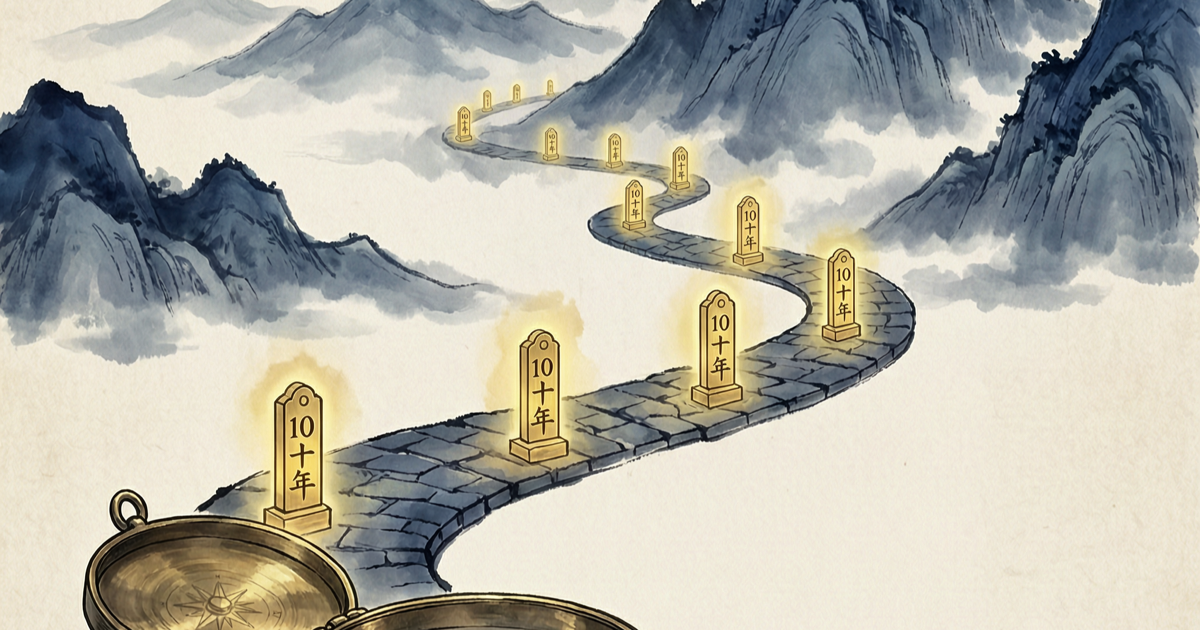
Fortune-tellers often say: "You'll have good luck after age 35." This "luck" refers to the Major Luck (Da Yun) in BaZi. It's not empty comfort, but a series of Stem-Branch (Gan Zhi) pairs derived from your birth chart, changing every ten years, determining the environment you walk into for that decade.
Many people know they have "Major Luck" but can't explain how it's arranged, how to read it, or why the same birth chart can have vastly different fortunes under different Major Luck cycles. This article explains Major Luck from the ground up: what it is, how it's arranged, how to judge the quality of a step, and how it interacts with the Annual Cycle (Liu Nian).
Bottom Line First
Major Luck is a "life phase" that changes every ten years, derived sequentially from your Month Pillar.
Think of it this way: Your BaZi birth chart is the hand of cards you're dealt at birth. Major Luck is the card table you'll sit at for the next ten years. With the same hand, sitting at a table that helps you (a Favorable God (Yong Shen) cycle) lets you play smoothly; sitting at a table that hinders you (an Unfavorable God (Ji Shen) cycle) makes even a good hand hard to play.
Reading Major Luck essentially answers one question: Is the environment of this decade favorable or unfavorable for my birth chart?
Remember three key points:
- Ten years per step, derived from the Month Pillar. Major Luck isn't random; it starts from your Month Pillar and proceeds forward or backward.
- Starting age varies by person. Some start at age 3, some at 9, determined by the days from your birth to the next seasonal node.
- Fortune depends on whether it helps you. Whether a Major Luck step is good or bad depends not on its own appearance, but on whether it supports or suppresses your Day Master's Favorable God (Yong Shen).
Try your own BaZi reading
Get an AI-powered personalized BaZi analysis from your birth info.
Start free analysisWhat Exactly is Major Luck?
The four pillars and eight characters of your BaZi represent your innate destiny—fixed at birth and unchanging for life. But people don't live in a vacuum; as you age, you enter different eras, circumstances, and environments. This flowing part is acquired luck.
Major Luck is the largest rhythm within "luck": changing every ten years. It's like the "acts" of a life play—each act lasts ten years, with a different stage setting. Your birth chart determines your role and abilities; Major Luck determines the stage you perform on for that decade.
That's why two people with nearly identical charts can have vastly different lives—one succeeds young, the other late. The difference often lies in the order of Major Luck cycles. Some get good luck early, hitting a Favorable God (Yong Shen) cycle in their twenties; others have a plain life until after fifty. Same destiny, different luck, divergent life paths.
How to Arrange Major Luck: Starting Age and Direction
Arranging Major Luck involves two things: which direction to go and at what age to start.
First, determine direction. Look at the Yin-Yang of the Year Pillar's Heavenly Stem (Tian Gan), combined with gender:
- Yang year (Jia, Bing, Wu, Geng, Ren) male, Yin year (Yi, Ding, Ji, Xin, Gui) female → Forward arrangement
- Yin year male, Yang year female → Backward arrangement
The mnemonic is "Yang male, Yin female forward; Yin male, Yang female backward."
Second, determine the Stem-Branch (Gan Zhi) sequence. Start from your Month Pillar: for forward arrangement, take the next Stem-Branch (Gan Zhi) after the Month Pillar and proceed sequentially; for backward arrangement, take the previous one and go backward.
Example: Suppose a Yang year male has a Month Pillar of Ren Wu (壬戌), so forward arrangement. His Major Luck starts from the next step after Ren Wu, in order:
Gui Wei (癸未) → Jia Shen (甲申) → Yi You (乙酉) → Bing Xu (丙戌) → Ding Hai (丁亥) → Wu Zi (戊子) → ……
Each step governs ten years, continuing downward.
Third, determine starting age. Count from the birth date: for forward arrangement, count to the next seasonal node (e.g., Start of Spring, Jingzhe); for backward, count to the previous node. The number of days is converted using "three days equals one year." For example, if birth is about 9 days from the node, start at about age 3; if 24 days, start at age 8.
Combining these three steps, if the male above starts at age 8, his Major Luck is: age 8 Gui Wei (癸未), age 18 Jia Shen (甲申), age 28 Yi You (乙酉), and so on. This is how fortune-tellers can say "you'll have such-and-such luck at age 35"—they literally count it from your sequence. If you don't want to calculate manually, just use the free BaZi chart generator to list your entire Major Luck sequence and starting age.
How to Read a Major Luck Step: Heavenly Stem and Earthly Branch Governing First and Last Five Years + Ten Gods + Favorable/Unfavorable
Arranging is only the first step; reading it is what matters. To read a Major Luck step, focus on three points:
1. Heavenly Stem and Earthly Branch govern the first and last five years respectively. A Major Luck step lasts ten years. Traditionally, the Heavenly Stem (Tian Gan) governs the first five years, and the Earthly Branch (Di Zhi) governs the last five years (some schools view the decade as a whole). So within the same step, the first and last five years may feel different—if the Heavenly Stem character is favorable, the first half goes smoother; if the Earthly Branch clashes, the second half sees more turbulence.
2. See which Ten Gods it brings. Place the Major Luck's Stem-Branch (Gan Zhi) into your chart and see what Ten Gods relationship it forms with the Day Master—Executive (正官), Maverick (傷官), Wealth Star, or Seal Star. A Wealth cycle emphasizes career and money; a Seal cycle emphasizes study, mentors, and support; a Maverick (傷官) cycle makes one want to break through and seek expression. The Ten Gods tell you the life theme of this decade.
3. See whether it helps or hinders your Favorable/Unfavorable Gods. This is the core of judging fortune. Whether a Major Luck step is good or bad depends not on the beauty of its two characters, but on whether the Five Elements (Wu Xing) it brings are what your Day Master needs (Favorable God (Yong Shen)) or excess (Unfavorable God (Ji Shen)).
- Brings Favorable God (Yong Shen) → Favorable cycle: things go smoothly, mentors appear, opportunities come to you.
- Strengthens Unfavorable God (Ji Shen) → Unfavorable cycle: effort yields little, obstacles recur, old problems resurface.
So "good luck" and "bad luck" are never absolute—the same Bing Fire (丙) Major Luck is warm sunshine for someone who needs fire, but adding fuel to the flame for someone already too fiery. This is why BaZi is more nuanced than simplistic one-line fortune-telling methods.
How Do Major Luck and Annual Cycle (Liu Nian) Combine?
Major Luck sets the decade's baseline, but within that decade, each year has its own fluctuations. These yearly waves are the Annual Cycle (Liu Nian).
Analogy: Major Luck is the "climate" of the decade—rainy season or dry season. Annual Cycle (Liu Nian) is the "weather" on a specific day—whether it's sunny or stormy. Even in a good Major Luck, there can be individual bad years; in a bad Major Luck, you can catch a breath of good years. To truly judge a year's fortune, you must overlay Major Luck + Annual Cycle (Liu Nian): Major Luck is the background, Annual Cycle (Liu Nian) is the current trigger.
Common example: A person in a strong Major Luck may still face minor relationship or health issues in a year that clashes with their Day Branch or Major Luck Stem-Branch (Gan Zhi). Conversely, in a bad Major Luck, a year that brings in the Favorable God (Yong Shen) can offer a rare opportunity. So don't judge solely by Major Luck; always overlay the current year's Annual Cycle (Liu Nian) for accurate timing and fortune.
To understand how to read Annual Cycle (Liu Nian) independently and why the same year affects everyone differently, read What is Annual Cycle (Liu Nian)? Why Does Everyone Have Different Fortune in the Same Year.
The Transition Year: Why Those Two Years Feel Especially Significant
Many people feel a clear life shift around the Major Luck transition—job changes, moving, marriage, health changes often cluster in the one or two years around the switch.
The reason is simple: the old decade's stage is dismantled, a new one is built, and the environmental background completely changes. If transitioning from bad to good luck, those two years feel like rain after a drought—"stuck things loosen up." Conversely, transitioning from good to bad luck often brings a downturn after glory. The transition point is the most critical time node in Major Luck—knowing it in advance allows preparation and rhythm adjustment. That's why fortune-telling places great emphasis on this "gear-shifting period"—it's often a window for life to reshuffle. Rather than being pushed by change, it's better to see the direction ahead and arrange proactively.
Insights for Ordinary People
Understanding Major Luck's greatest benefit isn't "predicting which year you'll get rich," but gaining confidence in life's rhythm:
- During bad luck, know it's a temporary environment, not your failure—consolidate, build strength, don't charge against the wind, wait for the next cycle.
- During good luck, know the opportunity window is limited—strike when the iron is hot, fully capitalize on the favorable table.
- Around transitions, proactively assess "whether to make major adjustments"—much more composed than being pushed by events.
Destiny is the innate hand, luck is the acquired momentum—you can't change the hand, but you can choose the right timing to play it.
Frequently Asked Questions
Q: At what age does my Major Luck start? It's determined by the days from birth to the next seasonal node, with three days equaling one year. So it varies per person, ranging from under 1 to over 10. A chart will directly show it.
Q: How many Major Luck steps are there? Theoretically, it can go on indefinitely, one step per decade. Common practice lists eight to ten steps, covering ages up to 80-90. Usually, looking at the current step and one or two before and after is sufficient.
Q: What if I haven't reached good luck yet? Bad luck isn't about resigning to fate; treat it as a "building period": protect your foundation, accumulate skills and connections, avoid high-risk moves against the wind. Luck will change; only those prepared can catch the next good wave.
Conclusion
Major Luck is the part of BaZi that best answers "What stage of life am I in now, and where am I headed?" It's not mystical—derived from the Month Pillar, ten years per step, judged by whether it helps or hinders your Favorable/Unfavorable Gods. The logic is clear.
Knowing your Major Luck sequence gives you a personal "life rhythm chart": when to push, when to hold. Generate a chart and see which step you're on now and what comes next.