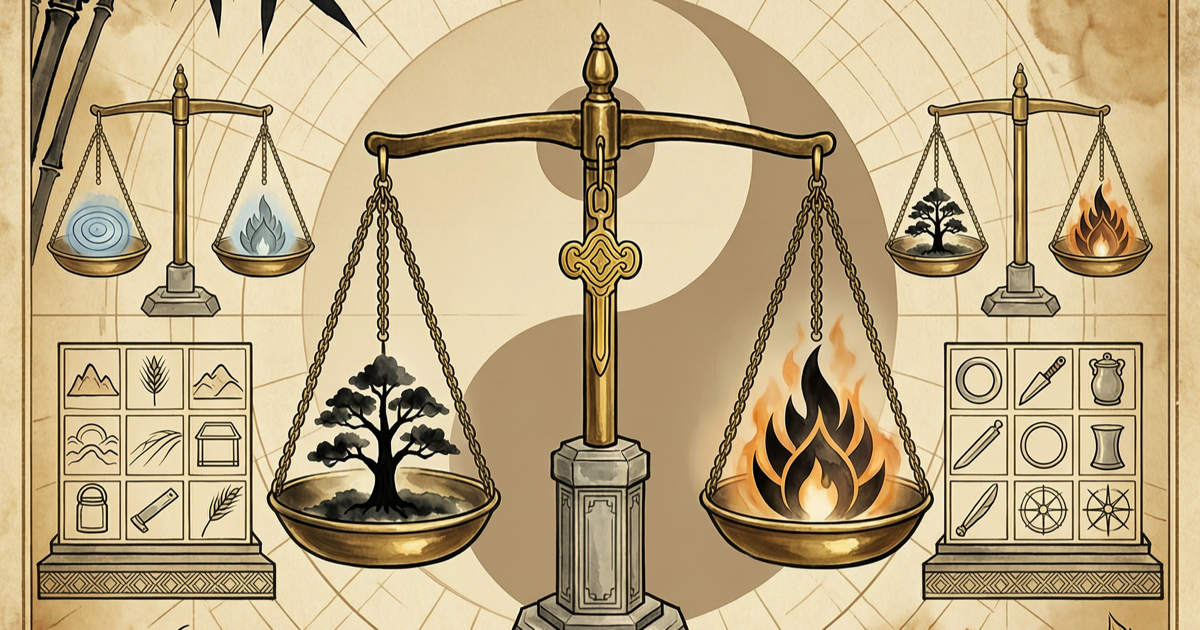
Determining whether the Day Master (日主) is strong or weak in BaZi comes down to three things: whether the Day Master has "Gained Command" (得令) — born in its own thriving month; whether it has "Gained Ground" (得地) — has roots in the earthly branches; and whether it has "Gained Momentum" (得勢) — has many allies. If two or more of these conditions are met, the Self is likely strong; otherwise, it is weak. The month order is the most important, counting as much as the other three pillars combined — that's why seasoned practitioners always look at the month branch first.
Try your own BaZi reading
Get an AI-powered personalized BaZi analysis from your birth info.
Start free analysisMany people get stuck at the first hurdle in BaZi: they can't determine vitality, and then everything else — the Favorable God (喜神) and the pattern — goes wrong. There's plenty of talk online about "what strong-self people are like" and "what weak-self people are like," but no one clearly explains "how to actually determine it." This article uses two real charts to walk you through step by step, so you can do it yourself by the end.
First, Let's Be Clear: What Are We Comparing?
Strong vs. weak Self isn't about "whether this person is capable or not." It's about whether the Day Master (the Heavenly Stem representing you) has enough power in this chart.
Think of it this way: the Day Master is like the home team in a game, and the entire chart is the match.
- Those who help the home team: the "Seal" (印) that generates it, and the "Peer" (比肩) and "Rival" (劫財) that are of the same type — these are allies.
- Those who drain it: what it generates, what overcomes it, and what it overcomes (Talent (食神), Maverick (傷官), Executive (正官), Warlord (偏官), Earner (正財), Venturer (偏財)) — these are opponents.
If there are many allies and they are powerful, the Self is strong; if there are many opponents and the Self is isolated, it is weak. Determining vitality is essentially counting the numbers and momentum of both sides in this match. And there are three fixed steps: Gaining Command, Gaining Ground, and Gaining Momentum.
First Look: Gaining Command — The Month of Birth Matters Most
"Command" refers to the month order, specifically the Earthly Branch of the Month Pillar. Why is the month order so important? Because BaZi deals with "energy," and the energy of the four seasons is determined by the month.
Spring is Wood-strong, Summer is Fire-strong, Autumn is Metal-strong, Winter is Water-strong, and the ends of seasons (Chen, Xu, Chou, Wei months) are Earth-strong. When the Day Master is born in its own thriving season, it is said to have "Gained Command," which is like playing on home turf — a huge innate advantage.
The rule for determining Gaining Command is simple: look at the relationship between the Day Master's Five Element and the month branch:
| Day Master Born In | Status | Vitality Tendency |
|---|---|---|
| Month of same element (e.g., Wood in spring) | In season, strongest | Strong |
| Month that generates it (e.g., Wood in winter Water month) | Generated, second strongest | Somewhat strong |
| Month it generates (e.g., Wood in summer Fire month) | Drained | Somewhat weak |
| Month that overcomes it (e.g., Wood in autumn Metal month) | Overcome | Weak |
| Month it overcomes (e.g., Wood in seasonal Earth months) | Exhausted | Somewhat weak |
One sentence to remember: The month order is the "big board" of vitality; one month order is worth as much as the other three pillars combined. Even if other aspects are lacking, a person who has Gained Command won't have a weak foundation.
Second Look: Gaining Ground — Does the Earthly Branch Have a "Root"?
Gaining Command alone isn't enough; we also need to see if the Day Master has its own root in the four Earthly Branches.
What is a "root"? It means that among the Hidden Stems (藏干) of the Earthly Branches, there is a character of the same type as the Day Master (Peer or Rival) or one that generates it (Seal). With a root, the Day Master is like a tree rooted in soil — stable and able to withstand overcoming and draining. Without a root, it's like duckweed — seemingly lively but easily scattered.
- Root in the month branch or day branch: the deepest and strongest root (especially the day branch, which is "your own home").
- Root in the year branch or hour branch: still counts as a root, but with reduced power.
- No same-type or generating element in any Earthly Branch: called "floating without root" — no matter how much Seal generates it, it remains weak.
In practice, checking roots means laying out the Hidden Stems of all four Earthly Branches and counting how many are helping you. This is why seasoned practitioners always look at Hidden Stems — the true strength of an Earthly Branch lies within.
Third Look: Gaining Momentum — How Many Allies Are There?
The first two looks are about "position"; the third is about "quantity": spread out all the Heavenly Stems and Hidden Stems of the entire chart, count the allies (Seal + Peer/Rival) versus opponents (Talent + Maverick + Wealth + Officer/Warlord) to see which side is more numerous.
The most intuitive method is to look at the Five Element ratio. Add up the two elements that generate or are the same as the Day Master:
- If allies clearly account for more than half (roughly 50% or more) → Gained Momentum, strong Self;
- If opponents are overwhelmingly dominant → Lost Momentum, weak Self.
But here's a common pitfall for beginners: many Seals do not equal strong Self. Seals do generate you, but too many or too strong Seals can actually cause "the mother being too strong makes the child weak" or "too much water drowns the wood" — the helpers are too forceful and overwhelm the protagonist. So Gaining Momentum can't just be about numbers; you need to see whether these helpers are "helping just enough" or "helping too much." This will be clear in the real charts below.
Practical Example 1: Lost Command but Strong Self (Wu Earth)
Theory is too abstract, so let's look at a real chart. This is a male born in March 1985, Day Master Wu Earth (戊土):
| Year Pillar | Month Pillar | Day Pillar | Hour Pillar | |
|---|---|---|---|---|
| Heavenly Stem | Yi (乙) | Ji (己) | Wu (戊) | Bing (丙) |
| Earthly Branch | Chou (丑) | Mao (卯) | Wu (午) | Chen (辰) |
| Ten Gods | Executive (正官) | Rival (劫財) | Day Master | Mystic (偏印) |
| Hidden Stems | Ji, Gui, Xin | Yi | Ding, Ji | Wu, Yi, Gui |
Five Element Ratio: Earth 45%, Wood 25%, Fire 20%, Water 8%, Metal 3%.
Let's go through the three steps:
- Gained Command? Wu Earth is born in the Mao month (spring, Wood strong). Wood overcomes Earth, so the Day Master loses Command — first check fails.
- Gained Ground? Look at the Earthly Branches: Day branch Wu (午) contains Ding Fire and Ji Earth (Fire generates Earth + same-type Earth, a good root); Hour branch Chen (辰) is Earth's native energy (same-type root); Year branch Chou (丑) also contains Ji Earth. Deep roots in the Earthly Branches — Gained Ground.
- Gained Momentum? Allies = Earth (45%) + Fire (20%, Seal generates Self) = 65%, opponents (Wood Officer, Metal Wealth, Water Wealth) total only 36%. Overwhelmingly many allies — Gained Momentum.
Among the three checks, although Command is lost, Gained Ground and Gained Momentum are both solid, and the Day Master Wu Wu (戊午) sits on Emperor (帝旺). Comprehensive judgment: Strong Self.
This is a type that beginners often misjudge — seeing only the lost month order and calling it weak Self, while missing the deep roots and numerous allies. The month order is important, but not the only factor.
Practical Example 2: Many Seals but Weak Self (Yi Wood)
Now look at a contrasting chart: a male born in December 1992, Day Master Yi Wood (乙木):
| Year Pillar | Month Pillar | Day Pillar | Hour Pillar | |
|---|---|---|---|---|
| Heavenly Stem | Ren (壬) | Ren (壬) | Yi (乙) | Wu (戊) |
| Earthly Branch | Shen (申) | Zi (子) | Chou (丑) | Yin (寅) |
| Ten Gods | Mentor (正印) | Mentor (正印) | Day Master | Earner (正財) |
| Hidden Stems | Geng, Ren, Wu | Gui | Ji, Gui, Xin | Jia, Bing, Wu |
Five Element Ratio: Water 38%, Earth 25%, Wood 19%, Metal 13%, Fire 5%.
Let's go through the three steps:
- Gained Command? Yi Wood is born in the Zi month (winter, Water strong). Water generates Wood, seemingly gaining generation, but winter water is too cold and strong — Wood is soaked and cannot grow. This is "generated" but not in season, so the foundation is weak.
- Gained Ground? Earthly Branches: Shen (Metal), Zi (Water), Chou (Earth), Yin (contains Jia Wood). The only root truly helping Yi Wood is Jia Wood in the Hour branch Yin — shallow and off-center (in the hour pillar, power is reduced).
- Gained Momentum? Allies = Water (Seal, 38%) + Wood (Peer/Rival, 19%) = 57%, numerically over half. But the key is — the Seal (Water) is as high as 38%, already causing "too much water drowning the wood." The helpers are too strong, and Yi Wood, a small grass, is overwhelmed by the winter water and cannot stand firm.
So although this chart has "strong Seals and numerical majority," in essence it is weak Self — the Seals are so many that they become a burden, not a help. This confirms the earlier point: Gaining Momentum depends on quality, not just quantity.
After the Three Checks, How to Conclude?
Here's a summary table to follow whenever you get a chart:
| Step | What to Check | Weight |
|---|---|---|
| First | Gained Command (Day Master vs. Month Branch) | Highest, equals three pillars |
| Second | Gained Ground (Hidden Stems in Earthly Branches) | Medium |
| Third | Gained Momentum (Allies vs. Opponents ratio) | Medium, but consider quality |
Judgment Principles:
- All three met → Strong Self (or even overly strong, exclusive strong);
- Two met (especially including Gained Command) → Strong Self;
- Only one or none met → Weak Self;
- Special note: Gained Command doesn't guarantee a win (it can be broken by combinations or clashes); many Seals don't equal Gained Momentum (they can become a burden).
Only after determining vitality can you move to the next step — identifying the Favorable God (喜神) and Unfavorable God (忌神). Simply put: strong Self individuals benefit from elements that drain, exhaust, or overcome them — Talent, Maverick, Wealth, Officer (to give excess energy an outlet); weak Self individuals benefit from elements that generate or help them — Seal, Peer, Rival (to replenish vitality). If the Favorable God is correct, subsequent analysis of Luck Cycles (大運) and Annual Cycles (流年) and patterns won't go completely wrong.
Can't Judge Accurately Yourself? Let a Real Chart Count for You
At the end of the day, the three-step rule isn't hard, but the subtleties of Gaining Command, the depth of roots, and the quality of allies — these require laying out the Hidden Stems and ratios of the entire chart to count carefully. Beginners easily miss things.
Try your own BaZi reading
Get an AI-powered personalized BaZi analysis from your birth info.
Start free analysisStrong vs. weak Self is just the first door to BaZi. But if you stand at this door correctly, the path ahead will be smooth. First, generate your own chart, then follow the three steps in this article — you'll find that you can understand it too.