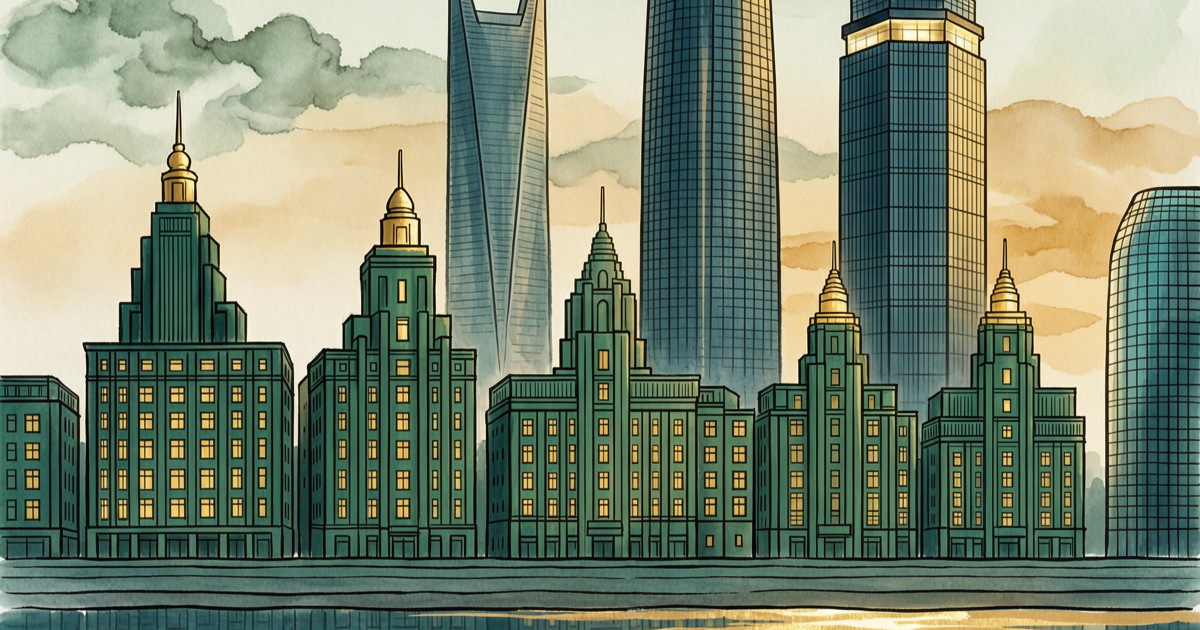
Trying to figure out what Beijing's Five Elements really are, many people instinctively say: Beijing is in the north, the north belongs to Water, so it must be Water, right?
From a directional perspective, that makes some sense. But once you stand on the central axis of the Forbidden City and feel that aura of stability, solemnity, and weight, you'll understand—Beijing's character has never been the flowing, light Water, but the steady, upright, and all-supporting Earth. It is a six-hundred-year-old imperial capital, a symbol of the center of the world, a city that 'sits in the center and receives tribute from all directions.' This energy of heaviness, authority, and stability can only be matched by one element in the Five Elements: Earth.
In this article, we'll use the same method from fortune analysis to examine cities and patterns, peeling back Beijing's Five Elements layer by layer.
Conclusion First
Beijing's core element is not Water, but 'Earth'—it is a city of central thick Earth and imperial qi.
- Character is Earth: In traditional Five Elements, the center belongs to Earth (土), governing power, stability, order, support, and virtue. As a millennium-old imperial capital, Beijing symbolizes the central position of 'dwelling in the center of the world, commanding all directions'—this is the very nature of Earth: heavy, upright, and able to support all things.
- Direction carries Water: Beijing is located in North China, leaning north, and the north belongs to Water (水), with a dry, cold climate and distinct seasons. This layer of 'Water' is its environmental backdrop, but not its primary qi.
- Earth generates Metal's authority: Thick Earth can generate Metal, and a center of power naturally breeds strict systems, rules, and rituals (Metal (金) governs rules and discipline). From the hierarchical severity of the Forbidden City to the orderly alignment of the central axis, these are all manifestations of 'Earth generating Metal.'
In one sentence: Beijing is an imperial capital of 'Earth as substance, Water as environment, Metal as function.' Its deepest undertone is the thick Earth qi of 'sitting at the center, supporting all directions.'
Try your own BaZi reading
Get an AI-powered personalized BaZi analysis from your birth info.
Start free analysisDirectional Elements: Beijing is in the North, So Why Isn't Its Primary Qi 'Water'?
In traditional fortune analysis, the classic formula for the Five Elements corresponding to directions is:
- East belongs to Wood (spring, growth)
- South belongs to Fire (summer, heat)
- West belongs to Metal (autumn, killing)
- North belongs to Water (水) (winter, cold)
- Center belongs to Earth (土)
Beijing is located on the northern edge of the North China Plain. From a broad directional view, it is indeed northward, with a dry, cold climate and long winters—this layer of 'northern Water' is its environmental backdrop, no doubt.
But here we need to distinguish one thing: 'geographical direction' and 'city character' are two different layers. A person born in winter doesn't necessarily have a Water-heavy BaZi; similarly, just because Beijing sits in the north doesn't mean its primary qi is Water. What determines a city's primary qi is its function and character—and Beijing's role for six hundred years has been the imperial capital of 'the center of the world.' In the symbolic system of the Five Elements, 'center' corresponds not to Water, but to Earth. So Beijing is 'physically in the northern Water land, but spiritually resides in the central thick Earth.'
Central Thick Earth: The Forbidden City and Beijing's Imperial Qi
To understand why Beijing belongs to Earth, we must understand the word 'center.'
In the Five Elements, Earth (土) governs center, support, heaviness, stability, trustworthiness. It is not like Wood's exuberant growth, nor Fire's outward radiance; Earth's power is 'sitting still in the center, supporting all directions.' And this is precisely the essence of an imperial capital:
- Dwelling in the center of the world: Ancient emperors considered themselves 'the central kingdom, the central position,' and the Forbidden City was regarded as the center point of heaven and earth, with tribute from all directions and nations coming to pay homage—this is the highest symbol of Earth 'dwelling in the center, commanding all directions';
- Upright and heavy pattern: Beijing's city layout is built on a central axis, symmetrical and square, from Tiananmen to the Forbidden City to the Bell and Drum Towers, a single line running north-south. This 'impartial, stable' urban skeleton is precisely Earth's uprightness and solidity;
- Support and stability: As a political and cultural center, Beijing bears the weight of national power, ritual systems, and historical gravity. Being able to bear, contain, and stabilize—this is Earth's core virtue.
Standing on the central axis of the Forbidden City, that aura of solemnity, stability, and dignified authority is the most intuitive experience of 'central thick Earth.' Beijing's soul is Earth.
Earth Generates Metal: Why Does a Power Center Breed Strict 'Metal'?
Thick Earth can generate Metal. A central power naturally grows a complete set of strict systems and rules—this is 'Earth generates Metal.'
In the Five Elements, Metal (金) governs rules, order, discipline, ritual, authority. As an imperial capital and political center, Beijing has no shortage of this 'Metal':
- Strict hierarchy and ritual: The order of rank and court etiquette within the Forbidden City is the ultimate expression of Metal's 'discipline and order';
- Rules and authority: As the governance hub, Beijing naturally carries an aura of 'setting rules and establishing laws,' which is Metal's killing and uprightness.
Thick Earth below, strict Metal above—the structure of Earth generating Metal gives Beijing both the heavy foundation to support all directions (Earth) and the authoritative rules to govern the world (Metal). This 'Earth-Metal' combination is the core Five Elements framework of the imperial capital.
Try your own BaZi reading
Get an AI-powered personalized BaZi analysis from your birth info.
Start free analysisHow to Determine a City's Five Elements: A Method for Everyone
After understanding Beijing as a 'central thick Earth' city, you've actually mastered a method applicable anywhere. To determine a city's elemental bias, you can cross-reference from four angles:
- Look at direction and climate: East (growth) leans Wood, South (heat) leans Fire, West (discipline) leans Metal, North (cold) leans Water, center leans Earth. This is the 'environmental element.'
- Look at function and character: Political power center, supporting all directions → Earth; finance and systems → Metal; trade and ports → Water; technology and culture radiance → Fire; talent growth and agriculture → Wood. Function often reveals the primary qi more than direction.
- Look at layout and architecture: Square, upright, symmetrical → Earth's order; dense steel skyscrapers → Metal; mountains and water embrace → Earth and Water.
- Look at historical role: Is the city 'sitting type' (Earth), 'flowing type' (Water), 'radiant type' (Fire), 'growing type' (Wood), or 'disciplining type' (Metal)?
Stack these layers, and you'll see not a simplistic answer like 'it's in the north so it's Water,' but a three-dimensional pattern. The same logic applies perfectly to your own BaZi—birth season is one layer of environment, while elemental strength and Favorable God are the framework layer; the latter determines what you truly thrive in, lack, and where you should go.
Try your own BaZi reading
Get an AI-powered personalized BaZi analysis from your birth info.
Start free analysisFAQ
Q1: Beijing is in the north, so does it belong to Water or Earth? Two layers. Environment belongs to Water (north, dry-cold climate), but character and primary qi belong to Earth (central imperial capital, supporting all directions). In one sentence: Beijing is a city 'physically in northern Water land, spiritually residing in central thick Earth'—the core is Earth.
Q2: Why does an imperial capital correspond to Earth and not another element? Because in the Five Elements, 'center belongs to Earth,' and emperors considered themselves 'the center of the world, commanding all directions.' Earth governs support, stability, and heaviness, which perfectly matches the role of a political power center 'sitting at the center, accommodating all directions.' Earth is also best at 'generating Metal,' nurturing the systems and rules needed to govern the world.
Q3: What use is knowing a city's Five Elements to me? The most practical use is matching: If your BaZi favors Earth (needing stability, foundation, support), a city with thick Earth like Beijing might be especially suitable for you to settle and develop; if you favor Water, Wood, or Fire, that's another choice. First figure out your own elemental likes and dislikes, then match them to the environment—much smarter than blindly following trends.
Conclusion
The question 'What element does Beijing belong to?' is most easily misled by the four words 'north belongs to Water.' But truly standing on the central axis and feeling that stable solemnity, you'll understand—Beijing's soul is Earth, not Water.
It is the central thick Earth (the imperial qi supporting all directions), the strict Metal born from thick Earth (the authoritative rules governing the world), and the northern Water is merely the cold land it resides in. Earth as substance, Water as environment, Metal as function—this is the Five Elements code of this millennium-old imperial capital.
And the same principle is hidden in your own BaZi. Are you a 'thick Earth, stable root' sitting-type pattern, or a completely different combination? First understand your own elements, then you'll know which land and which path are best for you to take root and shine.