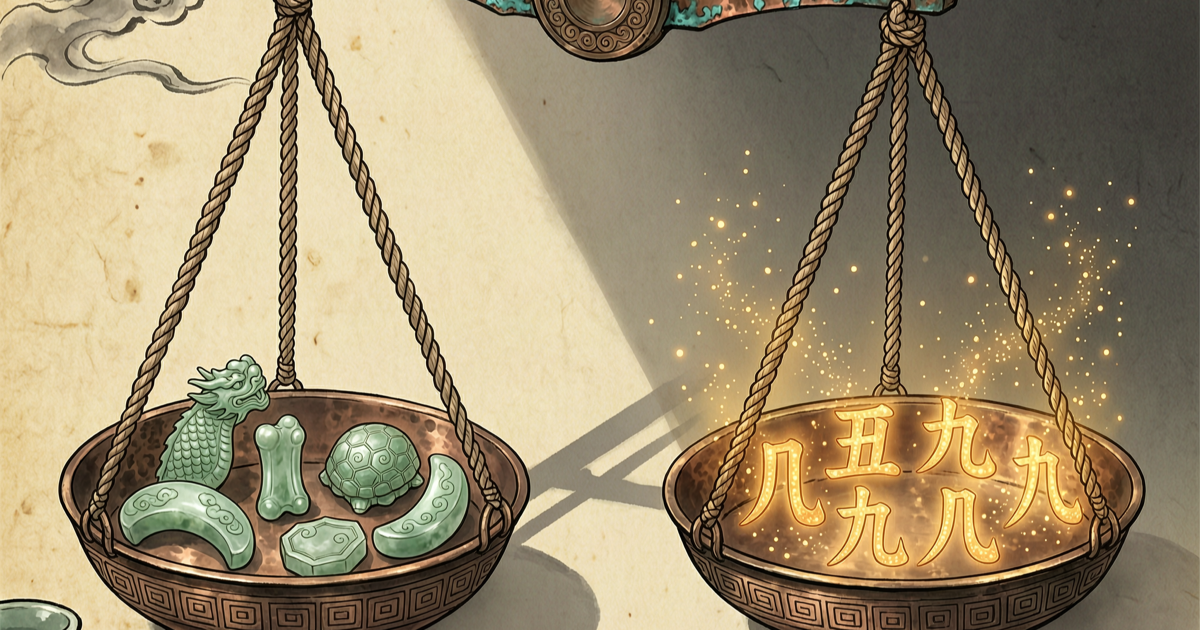
A quick online search for "BaZi weight calculation" yields your "liang and qian" in three seconds, paired with a fortune verse that looks quite convincing. But have you ever wondered: why do people born in the same year and month often get the same result as you? Is Yuan Tiangang's Bone Weight Method accurate, and how does it differ from real BaZi?
This article won't repeat "how to look up the table" (that's covered elsewhere). Instead, we address a more fundamental question: The "coarseness" of BaZi weight calculation is inherent—it merely adds four fixed numbers, making it a completely different level of tool from BaZi, which examines the generating and overcoming cycles of stems and branches. We also include a complete female bone weight interpretation for those who want to use this ancient method seriously.
Conclusion First
The Bone Weight Method (BaZi weight calculation) simply adds four "fixed weights" for year, month, day, and hour to get a total weight, then looks up a verse—it's a lookup system, not a fate analysis system. People born in the same year and month share the same year and month weights, so the year and month alone lock in a large portion, making it common for millions globally to "have the same fate weight."
In contrast, BaZi examines the generating and overcoming cycles, combinations, clashes, punishments, and harms among the Heavenly Stems and Earthly Branches—the same Ren Water Day Master born in summer versus winter, with Wood to drain or Metal to generate, leads to vastly different life paths. The granularity is completely different.
So the conclusion is simple: Treat BaZi weight calculation as a fun reference, but for serious fate analysis, return to BaZi itself. It's not a "simplified version of BaZi"; it's an earlier, coarser divination method.
Try your own BaZi reading
Get an AI-powered personalized BaZi analysis from your birth info.
Start free analysisHow Is BaZi Weight Calculation Actually Done?
First, understand the mechanism to see why it's "coarse."
Yuan Tiangang's Bone Weight Method algorithm has only one step: Match your birth year, month, day, and hour to fixed "weight values," add the four numbers to get a total weight (ranging from 2 liang 1 qian to over 7 liang), then look up the corresponding verse for fortune.
Example (for illustration only; numbers based on common versions):
| Pillar | Corresponding | Weight (qian) |
|---|---|---|
| Year Pillar | Example: Geng Wu Year | 9 qian |
| Month Pillar | Example: Seventh Month | 9 qian |
| Day Pillar | Example: Ninth Day | 5 qian |
| Hour Pillar | Example: Wu Hour | 1 liang |
| Total | Approx. 3 liang 3 qian |
Key point—these four weights are fixed values from a lookup table, with no interaction between them. The year is 9 qian regardless of the month or Day Master. This is the fundamental difference between "addition" and "generating and overcoming."
For a complete weight table for year, month, day, and hour pillars and the three-step algorithm, refer to our other article: How to Calculate Bone Weight: Complete Year, Month, Day, Hour Table. We won't repeat the full table here.
Is the Bone Weight Method Accurate? The Problem Is "Granularity Too Coarse"
Many ask "Is the Bone Weight Method accurate?" but that's the wrong question. Its issue isn't "whether it works," but its inherent resolution is insufficient. Let's break it down into three points:
1. Same Year and Month Lock in a Large Portion
The weights for the year and month pillars are shared by everyone born in the same year and month. That is, people born in a specific month in 2026 share identical year and month weights, differing only in day and hour.
As a result, millions globally share the same total weight. A single "fate description" applying to millions and still being accurate defies common sense.
2. Fixed Weights Ignore Combinations
What truly determines a person's fate is which of the Five Elements generates or overcomes which, which combine or clash. The Bone Weight Method completely ignores this layer—it only recognizes those four rigid numbers.
Analogy: The Bone Weight Method is like "weighing yourself," ignoring whether your 60 kg is muscle or fat, or your bone structure; same number, same category. BaZi, however, performs a complete body composition analysis.
3. Fortune Is Fixed in Verses
Each weight corresponds to a fixed verse with predetermined content. It doesn't change based on your Luck Cycle or Annual Cycle—it lacks a time dimension, whereas BaZi's core is precisely the progression of Luck Cycles and Annual Cycles.
To understand how BaZi predicts fate through the interactions of Heavenly Stems and Earthly Branches, these two entries are the best starting points.
Bone Weight vs. BaZi: A Table Showing Methodological Differences
Placing the two systems side by side makes the gap clear:
| Comparison Item | Bone Weight Method (BaZi Weight Calculation) | BaZi (Four Pillars Fate Analysis) |
|---|---|---|
| Core Action | Add four fixed weights | Generating and overcoming, combinations, clashes, punishments, harms of stems and branches |
| Input Precision | Year/month/day/hour → lookup table | Eight characters + Hidden Stems + Five Element strengths |
| Number of Same-Fate People | Same weight can reach millions | Identical BaZi is extremely rare |
| Time Dimension | None (one weight determines life) | Present (Luck Cycles, Annual Cycles progression) |
| Individualization | Very low (lookup table) | High (analyze entire chart combination) |
| Suitable Use | Fun, icebreaker | Serious analysis of personality, fortune, annual trends |
Understanding this table clarifies why "BaZi weight calculation is not a simplified version of BaZi"—simplification means reducing the same system, while the Bone Weight Method and BaZi are fundamentally different in logic. For historical origins and verification, see Is BaZi Weight Accurate? Complete Analysis of Bone Weight Method vs. BaZi.
Female Bone Weight Table: Complete Weight Interpretation Reference
Although the Bone Weight Method is coarse, if you use it, use it correctly. The Bone Weight verses differ for males and females (same algorithm, different interpretations). Below is a summary of common female bone weight interpretations from folk versions, for fun reference only:
| Female Bone Weight | General Interpretation |
|---|---|
| 2 liang 1 qian – 2 liang 9 qian | Early years are harder, requires self-effort, improves in middle and old age |
| 3 liang – 3 liang 9 qian | Food and clothing sufficient but laborious, marriage needs careful management |
| 4 liang – 4 liang 9 qian | Above-average fortune, good at managing household, good children luck |
| 5 liang – 5 liang 9 qian | Wealthy fate, receives much help from nobles, harmonious family |
| 6 liang – 6 liang 9 qian | Great wealth and nobility, both fortune and longevity, fame and profit |
| 7 liang and above | Extremely noble fate, rare in the world |
Two things to note:
- The female table differs from the male table in interpretation. For the same 4 liang, male and female verses differ. For a side-by-side comparison, see Bone Weight Fate Comparison: Same 4 Liang, Why Are Male and Female Fates So Different?.
- "Heavier weight means better fate" is an oversimplified impression. Verses for lighter weights can describe good fates, and heavier weights can describe laborious lives. Don't judge fortune solely by the number.
How Would BaZi Analyze a "4 Liang" Female Fate?
BaZi would never classify by "female 4 liang." Instead, it asks:
- What is the Day Master? Ren Water, Jia Wood, or Ding Fire? This determines your fundamental character and preferences.
- What season were you born in? Same Ren Water, born in winter (Water strong) versus summer (Water weak) leads to completely opposite fates.
- How do the Five Elements flow in the entire chart? Are there Ten Gods like Executive (正官) or Earner (正財) forming patterns, or Maverick (傷官) and Warlord (七殺) causing disruption?
- Where is the Luck Cycle? The same BaZi at age 20 versus 50 faces entirely different fortune windows.
These four questions cannot be answered by the Bone Weight Method—because it only has the number "4 liang." That's why for serious fate analysis, you must generate the complete birth chart rather than stop at a single weight.
Advice for Ordinary People: How to Use the Bone Weight Method Without Pitfalls
I'm not telling you not to play with bone weight, but to place it correctly:
- Use it for fun, as an icebreaker. Calculate a weight, recite a verse—great for parties with friends.
- Don't use it for life decisions. Marriage, career, home buying—don't limit yourself because "I'm only 3 liang 2"—that's the same sentence applied to millions.
- For serious fate analysis, return to BaZi. Generate a complete birth chart with your birth year, month, day, hour (preferably with birthplace), and examine the Day Master, Ten Gods, Five Elements strengths, and Luck Cycles for individualized reference.
- Ensure accurate birth time. Whether for bone weight or BaZi, an incorrect time skews conclusions; BaZi is more particular about True Solar Time correction.
Frequently Asked Questions
Q: Is the Bone Weight Method accurate? Can it be trusted? A: It's fine as a fun reference, but don't use it as a life guide. Its "same-fate population" can reach millions, making descriptions too generic for individualized accuracy.
Q: Are BaZi weight calculation and BaZi the same thing? A: No. BaZi weight calculation is "adding four fixed numbers and looking up a table"; BaZi is a comprehensive analysis of "stem-branch generating and overcoming cycles." The granularity differs greatly; they are not a simplified relationship.
Q: Why do female and male bone weight tables differ? A: The algorithm (weight lookup) is the same, but the verse interpretations are divided into male and female sets, reflecting ancient social role divisions, which are somewhat distant from modern BaZi concepts.
Q: Does a heavier weight mean a better fate? A: Not necessarily. Verses for lighter weights can describe good fates, and heavier weights can describe laborious lives. Don't judge fortune solely by the number.
Conclusion
BaZi weight calculation is popular because of its low barrier: "results in three seconds, understandable by everyone." But the cost of this low barrier is compressing millions of people into the same verse. It's not wrong; it's just too coarse—suitable for fun, not as the judge of your life.
If you truly want to know how your life will unfold, don't stop at "how many liang." Generate your complete BaZi chart, examine the Day Master, Ten Gods, and Luck Cycles—that's the chart that belongs to you alone.
Ultimately, the Bone Weight Method is a "quick version" fortune-telling method invented by ancient people without calculation tools—its value lies in simplicity and popularity, not precision. Today, we have more refined tools; why stop at a single weight? Arrange your birth year, month, day, and hour into a complete birth chart, see your Day Master, Ten Gods, and Luck Cycle trends—that's the truly personalized fate reference for you.
If you're curious about what your real birth chart looks like, why not generate one yourself, upgrading from a single weight to an entire chart that is uniquely yours.