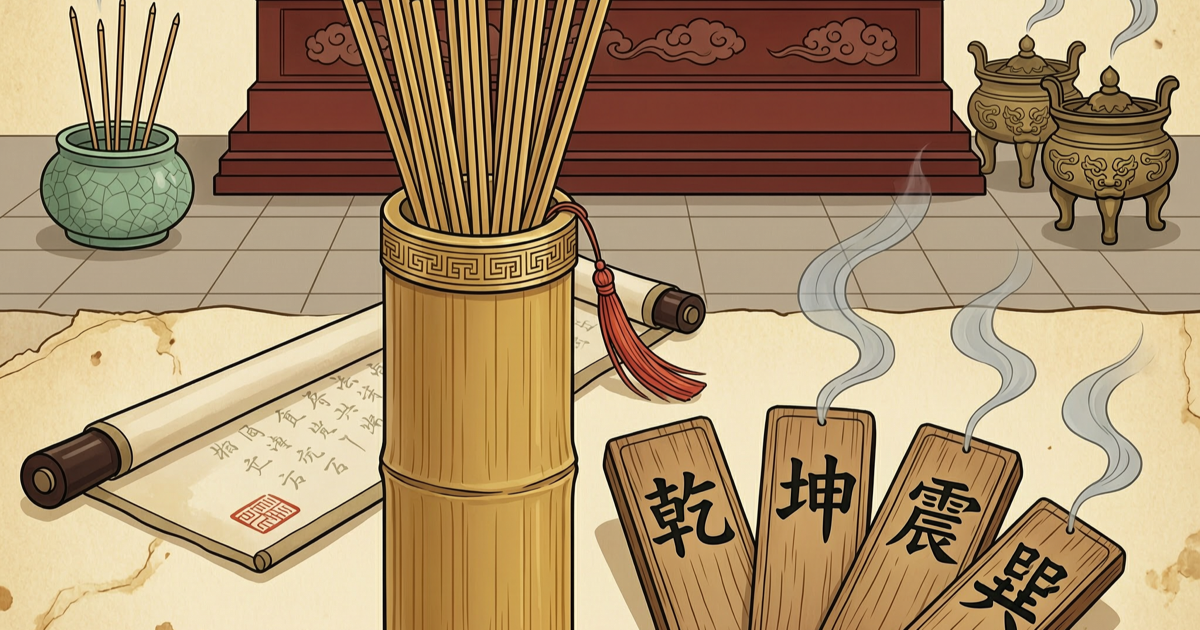
Before seeking Guan Gong's fortune sticks, many people have the same thought swirling in their minds: What is this stick I drew really telling me?
Let's get straight to the point: Guan Gong's fortune sticks are not meant to 'calculate what will happen to you,' but to help you sort out a messy situation and find a direction: 'should I advance or hold back now.' The poem you draw has no magic power in itself. What truly works is that you bring a clearly stated question before Lord Guan, calm your mind, and then use the poem as a mirror to re-examine your situation. So when reading Guan Gong's sticks, the focus is never on the two characters 'upper-upper' or 'lower-lower,' but on the four-line poem: what does it hint at—'move' or 'stay,' 'now' or 'wait'?
Try your own BaZi reading
Get an AI-powered personalized BaZi analysis from your birth info.
Start free analysisWhat Are Guan Gong's Fortune Sticks? A Clear Explanation of Their Origin
Many people don't know that the set of 'Guan Gong's Fortune Sticks' found in temples is actually called 'Lei Yu Shi One Hundred Sticks' (雷雨師一百籤). Legend has it that these poems were bestowed by the 'Immortal Thunder and Rain Master' and later widely enshrined before Guan Sheng Di Jun (Guan Gong). Thus, folk tradition simply calls them Guan Di Sticks or Guan Gong Sticks. There are 100 in total, making them the most widely circulated and life-relevant set of fortune sticks in Chinese folk culture.
Why do people particularly love seeking Guan Gong's sticks? Because Guan Sheng Di Jun symbolizes 'loyalty, righteousness, uprightness, and clear judgment' in Chinese folk belief. When facing career bottlenecks, legal disputes, business success or failure, or moments requiring a decisive choice—'should I go for it?'—people turn to Guan Gong for advice. Guanyin's sticks tend to be gentle and compassionate, while Guan Gong's sticks are straightforward and decisive, especially suitable for questions about career, wealth, legal matters, and decision-making—things like 'should I act or not?'
To understand Guan Gong's fortune sticks, remember one thing: They ask 'what should I do about this matter now,' not 'what is my destiny in this life.' This distinction is the most critical line when we later compare with BaZi.
How to Ask for Guan Gong's Fortune Sticks? Sincerity + Confirmation with Divination Blocks
Whether you go to a temple or use an online stick-drawing method, the spirit of the process is the same; the difference is only in the complexity of the ritual:
- Calm your mind and state your name: First, quiet your mind, put your hands together, and report your name, birth date, and current residence to Guan Sheng Di Jun. This step is not just for show; it forces you to 'truly be present' and focus your attention on yourself.
- Silently state your question, and be specific: In your mind, clearly articulate what you want to ask. Don't ask 'Will my luck be good?' Ask 'Should I sign this cooperation agreement?' or 'Should I quit this job?' The more specific your question, the better the poem will match. Ask only one thing at a time; don't be greedy and ask five things at once.
- Confirm with divination blocks: After drawing a stick, you must use divination blocks to ask Guan Gong if this stick is meant for you. Getting a sacred block (one flat, one round) means confirmation, and you can proceed to read the poem. If you get a laughing block (both flat, as if the deity is laughing at your unclear question) or a yin block/covered block (both round, meaning no, or the timing is not right), you should calm your mind again, rethink your question, and draw again.
- Read the poem and interpretation: Take the stick number to the corresponding poem, and read the poem, the historical allusion, and the interpretation together.
Online stick-drawing simplifies 'shaking the stick container + throwing blocks' into random number selection, saving the physical ritual. But one step absolutely cannot be omitted—'think your question through clearly before drawing.' This is where the real value of seeking a stick lies, not in the act of drawing itself.
The Structure of Guan Gong's Stick Poems: Don't Just Look at the Auspiciousness
The format of Guan Di's hundred sticks is more complete than ordinary poems. A complete Guan Gong stick usually includes these layers:
| Layer | Content | How to Read |
|---|---|---|
| Stem-Branch・Stick Number | e.g., 'Jia Zi・First Stick' | Numbering for easy reference |
| Auspiciousness | Upper-Upper / Upper-Auspicious / Medium-Auspicious / Medium-Flat / Lower-Lower | Just the overall tone, not a verdict |
| Stick Head Story (Allusion) | A historical story of an ancient person | Use the ancient person's situation to mirror your own |
| Stick Poem | A four-line poem | Look at imagery, movement vs. stillness, timing |
| Sacred Intent・Dongpo Interpretation・Bixian Commentary | Annotations by famous scholars throughout history | Supplement the poem's meaning from multiple angles |
| Interpretation・Explanation | Vernacular itemized explanations | Correspond to family fortune, marriage, career, wealth, seeking children, legal disputes, etc. |
Many people, upon drawing a stick, only look at the words 'upper-upper' and feel happy, or 'lower-lower' and panic—this is the biggest misconception in reading sticks.
The key is: Stick poems speak through 'imagery.' The same medium-flat stick, when asked about career, might mean 'wait a little longer, the timing isn't right,' but when asked about relationships, it might mean 'plainness is a blessing, don't stir things up.' So reading Guan Gong's sticks is not about checking an auspiciousness comparison table; it's about placing that four-line poem back into your specific question and seeing if it hints at 'advance' or 'retreat,' 'move' or 'stay,' 'now' or 'wait.' The ancient story at the head of the stick is especially important—Guan Gong's sticks particularly like to use the successes and failures of historical figures as metaphors. The ending of that story is often the hint for you.
Common Questions: How to Match the Poem to Your Situation?
After drawing a stick, the hardest part is often 'which matter of mine is this poem talking about?' Here are some of the most frequently asked situations:
Asking about career: Don't just look at auspiciousness; look at 'movement vs. stillness.' If you draw a poem full of imagery like 'wait quietly,' 'maintain the status quo,' 'don't force it,' even if the head says 'medium-auspicious,' it is advising you to hold back now, don't rush to jump. Conversely, if the poem has imagery of upward momentum like 'dragon gate,' 'passing the exam,' 'great prospects,' then it is truly encouraging you to act.
Asking about relationships: Look for hints of 'union' or 'separation.' When Guan Gong's sticks are asked about marriage, focus on whether the poem contains imagery of coming together like 'phoenix and mate harmonize,' 'finally become a couple,' or imagery of separation like 'water flows, flowers fall,' 'each goes their separate way.' A medium-flat stick for relationships mostly means 'let it be, don't force it.'
Asking about wealth/business: Look at 'timing,' not 'amount.' The poem won't tell you how much you'll earn; it tells you whether now is a good time. If the poem has words like 'wait for the time,' 'autumn harvest,' it means don't rush. If it has words like 'spring breeze,' 'timely,' then it's a green light.
What if I draw a lower-lower stick? Don't panic. A lower-lower stick is not a death sentence; it is reminding you that now is not the time to act rashly—treat it as a signal to 'hit the brakes,' not a verdict of 'it's over.' Many people have avoided impulsive decisions precisely because a lower-lower stick made them stop.
Can I ask the same question repeatedly? Not recommended. Repeatedly drawing for the same thing means you don't trust the first answer and just want to hear what you want to hear—this goes against the spirit of 'sincerity.' It's better to change the time, think your question through more clearly, and then ask again.
How Does BaZi View Guan Gong's Fortune Sticks? What's the Difference?
This is the part Shunshi most wants to discuss with you. Sticks and BaZi are often confused, but they are actually tools from two completely different dimensions:
| Guan Gong's Fortune Sticks | BaZi Birth Chart | |
|---|---|---|
| Asks | What should I do about this matter now? | Who you are, the lifelong pattern and trends |
| Time Scale | Present, near future | Innate destiny + 10-year Luck Cycles + Annual Cycles |
| Nature | Instant 'timing snapshot' | Long-term 'destiny map' |
| How to Use | Ask for direction when stuck | Look at patterns, fortune fluctuations |
To use an analogy: BaZi is your car's 'factory specifications' plus the 'entire route map'—how big the engine is, how deep the fuel tank is, whether the next ten years are uphill or downhill. Guan Gong's sticks are the real-time navigation when you reach a certain intersection, asking 'should I turn at this corner now?'
The two are actually complementary:
- First, use BaZi to see the foundation: Your Day Master's strength and Ten Gods structure determine 'what you are good at and where you easily get stuck.' The Luck Cycle and Annual Cycle tell you 'whether you are on an uphill or downhill slope now.'
- Then, use Guan Gong's sticks to ask about timing: Within the general direction given by BaZi, when you encounter a specific matter and can't make up your mind, draw a stick to help you converge on a current judgment.
Here's a practical example: Your BaZi this year is in an Annual Cycle where 'unfavorable gods are in power, not conducive to hasty action.' If you then seek a career stick and draw a medium-flat one advising you to 'maintain the status quo and wait for the right time'—both tools are saying the same thing, corroborating each other, and you'll feel more at ease. Conversely, if you don't even know where your Annual Cycle is this year, or what your Day Master likes and dislikes, making a major life decision based solely on a stick is like only looking at one turn in the navigation without knowing where the entire road leads.
First, lay out the map of your birth chart, then seek Guan Gong's sticks. Only then can the poem truly connect with your life.
A Pragmatic View of Fortune Sticks: They Don't Predict; They Help You See Clearly
Finally, let's be straightforward. Whether Guan Gong's fortune sticks are accurate depends on you:
- They are a 'convergence tool,' not a 'prediction machine.' Their greatest value is to compress the anxiety of 'should I, is it good, will it happen' into a direction you can judge. After drawing a stick, you often don't 'know the future,' but rather 'the answer that was already in your heart is now seen.'
- 'Sincerity brings spiritual response' is not superstition; it's a mechanism. Calming your mind and asking a specific question works because the poem is a blurry mirror. The clearer the question you bring to it, the clearer the image it reflects.
- You cannot use it to bet on specific events. Questions like 'Will I win the lottery?' cannot be answered by the poem. It excels at questions of mindset and timing, like 'Should I advance or hold back now?'
Seeking a stick is a ritual to calm yourself down and think through a problem clearly. BaZi is a map to understand your long-term trends. Use both together: the stick helps you decide in the moment, and the birth chart helps you see the big picture.
Try your own BaZi reading
Get an AI-powered personalized BaZi analysis from your birth info.
Start free analysis