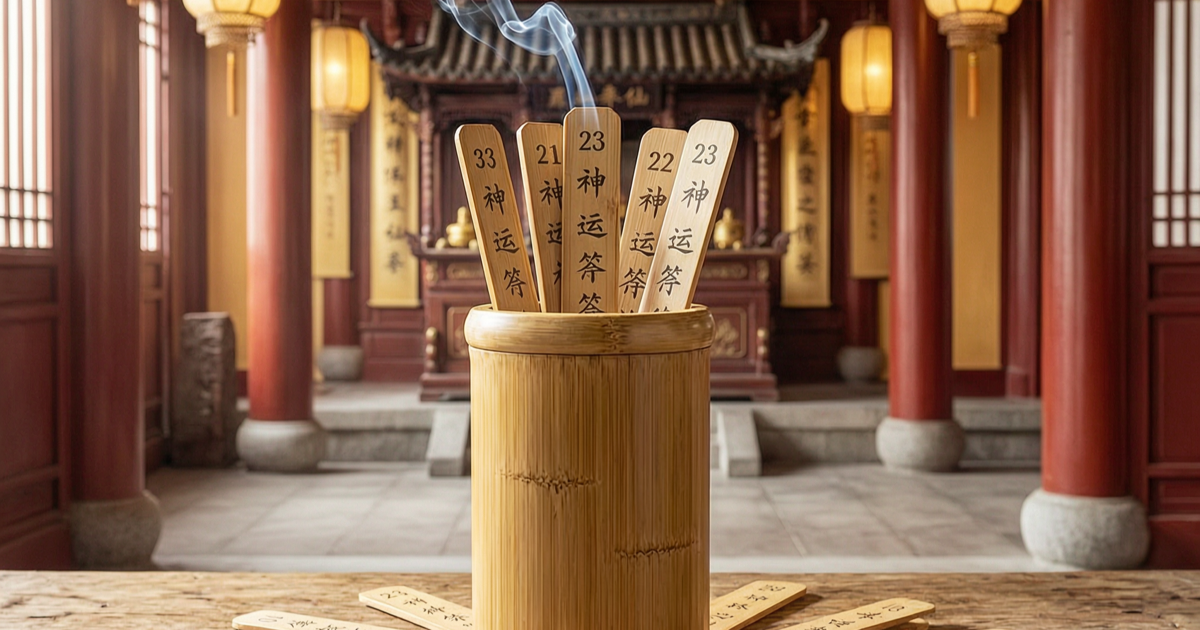
When Hongkongers face festivals, job changes, moving houses, or seek love or career, the first place that comes to mind is often Wong Tai Sin. The spectacle of vying for the first incense on Lunar New Year's Day is already a collective memory of Hong Kong. But have you ever thought that drawing fortune sticks actually involves a complete set of procedures and etiquette, and the key to interpreting the stick is not about whether it is "accurate"?
Bottom Line First
The core of drawing fortune sticks at Wong Tai Sin (Sik Sik Yuen Wong Tai Sin Temple) is to use a stick poem to reflect your current situation, not to predetermine your future. The complete process is: ① Offer incense and state your name, address, and the matter you wish to ask → ② Kneel and shake the stick container until one stick falls out → ③ Remember the stick number (Wong Tai Sin has 100 sticks) → ④ Cast the divination blocks (sheng bei) to confirm whether this stick is meant for you → ⑤ Take the stick number to a fortune-telling stall or look up the stick text yourself. Sticks are graded as top-top, top-auspicious, middle-auspicious, middle-flat, and bottom-bottom, but drawing a bottom stick does not mean bad luck; it is more of a reminder to be cautious, restrain yourself, and wait for the right time.
Treating the Wong Tai Sin sacred stick as a "mirror of your current situation" rather than a verdict of fate is the way Shun Shi has always believed: fortune analysis is used to understand your situation and go with the flow, not to scare yourself.
Try your own BaZi reading
Get an AI-powered personalized BaZi analysis from your birth info.
Start free analysisWho is Wong Tai Sin? Why Do Hongkongers Trust Him Most?
Wong Tai Sin, originally named Huang Chuping, is said to be a shepherd boy from Jinhua, Zhejiang during the Eastern Jin Dynasty. After attaining immortality, he became famous for "granting every request". The center of Wong Tai Sin worship in Hong Kong is the Sik Sik Yuen Wong Tai Sin Temple in Chuk Yuen, Wong Tai Sin District, built in 1921. It integrates Confucianism, Buddhism, and Taoism, which is why it is particularly down-to-earth and accessible to all sects.
Hongkongers' trust in Wong Tai Sin stems from several practical reasons:
- Reputation for granting requests——You can pray for love, career, health, wealth, almost anything, with low barriers and no taboos.
- Tied to festivals——The spectacle of vying for the first incense on Lunar New Year's Day and the grand celebration of Wong Tai Sin's birthday (23rd day of the 8th lunar month) have become part of Hong Kong's annual customs.
- Mature stick system——100 sticks with complete poems and interpretations, numerous fortune-telling stalls, and help available if you can't read them yourself.
One thing to note: Wong Tai Sin worship is a folk belief, and drawing sticks is a ritual of psychological anchoring and self-dialogue, not scientific prediction. Understanding this will help you draw sticks with peace of mind.
The Process of Drawing Fortune Sticks at Wong Tai Sin: Step by Step
If it's your first time, you may not know where to start. Below is the standard procedure at Sik Sik Yuen Wong Tai Sin Temple:
1. Offer Incense and Make a Wish
First, offer incense at the main hall, press your palms together, and silently recite your name, birth year, and current address. Then clearly state what you want to ask——for career, ask about career; for love, ask about love. Ask only one question at a time; don't be greedy and ask everything at once. The more specific the question, the more relevant the stick text will be.
2. Shake the Stick Container
Kneel on the cushion, hold the stick container with both hands, tilt it slightly forward and shake, while continuously silently reciting your question. Shake until one stick falls out (if several fall out, put them all back and shake again). Remember the stick number on the stick——Wong Tai Sin sticks range from number 1 to 100.
3. Cast the Divination Blocks for Confirmation (Sheng Bei)
After drawing the stick, don't immediately go to interpret it. Pick up a pair of divination blocks (sheng bei) and ask: "Wong Tai Sin, is this stick number X granted to your disciple?" Then cast the blocks:
- One flat, one round (sheng bei) = Approved, this stick is yours.
- Both flat sides up (xiao bei) = The deity is smiling; the question may not be clear enough. You can restate your wish and ask again.
- Both round sides up (yin bei) = Not approved; you need to shake again.
Generally, three consecutive sheng bei is the most reliable, but many people accept one sheng bei.
4. Receive the Stick Text and Interpret
Take the confirmed stick number to the stick counter to exchange for the corresponding stick text paper, or go to a fortune-telling stall to have a master interpret it. The stick text usually includes a four-line poem + a story + interpretation (for career, love, wealth, health, travel, etc.).
The 100 Sticks of Wong Tai Sin: How to Read Upper, Middle, and Lower Sticks
Wong Tai Sin has a total of 100 sticks, each with a luck level. The common grading from best to worst is roughly:
- Top-top stick——Best, everything goes smoothly; you can act boldly.
- Top-auspicious / Top stick——Auspicious, direction is correct; effort will be rewarded.
- Middle-auspicious / Middle-flat——Stable, neither good nor bad; better to hold steady than to rush.
- Bottom-bottom / Bottom stick——A reminder to be cautious; during this period, it's better to restrain yourself and wait for the right time. It does not mean disaster is imminent.
Three key principles for interpreting sticks:
- Stick text > Grade. Many people panic when they see a "bottom stick", but the four-line poem and interpretation are the real focus. The same middle-flat stick can have completely different interpretations for career and love.
- Focus on the item you asked about. If you asked about love, focus on the "love" section; don't be scared by the "wealth" section.
- The story is a metaphor, not literal. The stick poems often use historical figures and ancient stories as metaphors (e.g., allusions to "Han Xin" or "Su Wu"). The key is the metaphor of that situation, not that you should replicate the ancient outcome.
Etiquette for Drawing Sticks and Precautions for Interpretation
Several rules that older generations in Hong Kong often mention:
- Dress neatly and be respectful——Don't treat it as a game.
- One matter, one stick——For the same matter, don't repeatedly draw sticks in a short period; drawing until you get a favorable answer is self-deception.
- Ask sincerely——If you are distracted or perfunctory, the stick text will naturally not match.
- Interpret according to the specific item——If asking about career, read the career section; don't interpret the whole stick randomly.
- Don't rely on it excessively——The stick is a reference, a reminder; the decision is always in your hands.
As for interpretation, the safest way is to consult a fortune-teller at the temple; if you read it yourself, remember to read the poem and interpretation together, and then understand it in the context of your actual situation. Don't take it out of context.
Drawing Sticks vs. BaZi: What's the Difference Between These Two "Fortune-Reading" Methods?
Hongkongers often confuse drawing sticks with fortune-telling, but they are completely different tools:
- Drawing sticks is a one-time, immediate, single-issue divination——you ask "Is it good to change jobs this month?", and the stick text answers that one matter. It's a snapshot.
- BaZi birth chart is a structural, long-term, overall analysis——it consists of the four pillars of your birth year, month, day, and hour, and looks at your entire life's innate pattern and the rhythm of your Luck Cycles and Annual Cycles.
For example: You draw a "bottom stick" telling you to hold steady now. This is just a hint for this moment. But a BaZi chart can tell you what Luck Cycle you are in, how the Five Elements' energy will flow in the coming years——whether you really need to hold steady or if you are actually in a rising period. The two do not conflict——the stick is a point, BaZi is a line.
To see the big picture, you can first understand the basics of BaZi: The Generating and Overcoming Cycles of the Five Elements (Wu Xing) determine the flow of energy in your chart, while the Ten Gods pattern shows your relationship with wealth, authority, mentorship, and talent——these are depths that a single stick cannot provide. If you want to see your own chart, you can use our free BaZi calculator; enter your birth time to get a complete chart.
Treat the Sacred Stick as a Mirror: Shun Shi's Way of Reading
Shun Shi has always believed in one concept: Fortune analysis is not for gambling on the future, but for understanding the present and going with the flow. The reason Wong Tai Sin's sacred sticks are "spiritual" is not that they can predict good or bad luck, but that——
When you sincerely state your wish, shake out a stick, and read the poem line by line, you are actually forced to pause and seriously face that question of yours. The stick text is like a mirror, reflecting the answer already in your heart, or the situation you have been unwilling to face. Drawing a top stick gives you the confidence to keep going; drawing a bottom stick gives you a reminder to slow down and avoid risks.
This kind of externalization——projecting confusion onto a stick or a birth chart——is precisely how Eastern fortune analysis heals the heart. Western psychology tells you to "introspect and change yourself"; the wisdom of Eastern fortune analysis is the opposite——it does not ask you to wrestle with yourself head-on, but to project your confusion outward, using a stick or a chart to re-understand your situation, and then decide your next step.
So drawing a stick correctly is not about seeking a "100% accurate" answer, but about seeking peace of mind: knowing whether to advance or hold steady at this moment, knowing that you are not alone. After drawing the stick, if you want to go deeper, from "this moment" to "this year, these years", then the BaZi chart comes into play——it does not look at a snapshot of a single issue, but at the long-term trend of your entire pattern and Luck Cycles. It does not ask you to "change yourself", but allows you to accept your situation and move with the timing.
Frequently Asked Questions
Q: Do I need to pay to draw fortune sticks at Wong Tai Sin? Entering the temple is free. Stick containers and stick text papers are usually available for free or by donation at the stick counter. If you consult a fortune-teller at a stall, you need to pay a fee, which varies by stall.
Q: What if I draw a bottom-bottom stick? Don't panic. A bottom stick is a reminder to hold steady and be cautious during this period; it does not mean great misfortune. Focus on the specific content of the poem and interpretation, corresponding to the matter you asked about, and treat it as a kind reminder to "slow down".
Q: How many times can I draw sticks for the same matter? In principle, one matter, one stick. Repeatedly drawing for the same matter in a short period until you get a favorable answer is self-deception and defeats the purpose of divination. If the divination blocks keep not approving, you can wait for a while and ask again when your mind is calmer.
Q: Which is more accurate, drawing sticks or BaZi fortune-telling? It's not a question of "which is more accurate", but different purposes. Drawing sticks answers a single, immediate question; BaZi looks at the overall pattern and rhythm of your entire life. If you want to see the big picture and know your long-term luck, a BaZi chart provides far more information than a single stick.
Conclusion
Wong Tai Sin's sacred sticks carry the hopes of generations of Hongkongers. The act of drawing a stick itself is a ritual of sincerely facing yourself. Remember: The stick is a mirror, not a verdict. Don't get carried away with a good stick, and don't panic with a bad one——what truly helps you see the long-term and move with the rhythm is understanding your own birth chart.
If you want to go from "drawing a stick" to "seeing the whole picture", start by understanding your own BaZi chart.