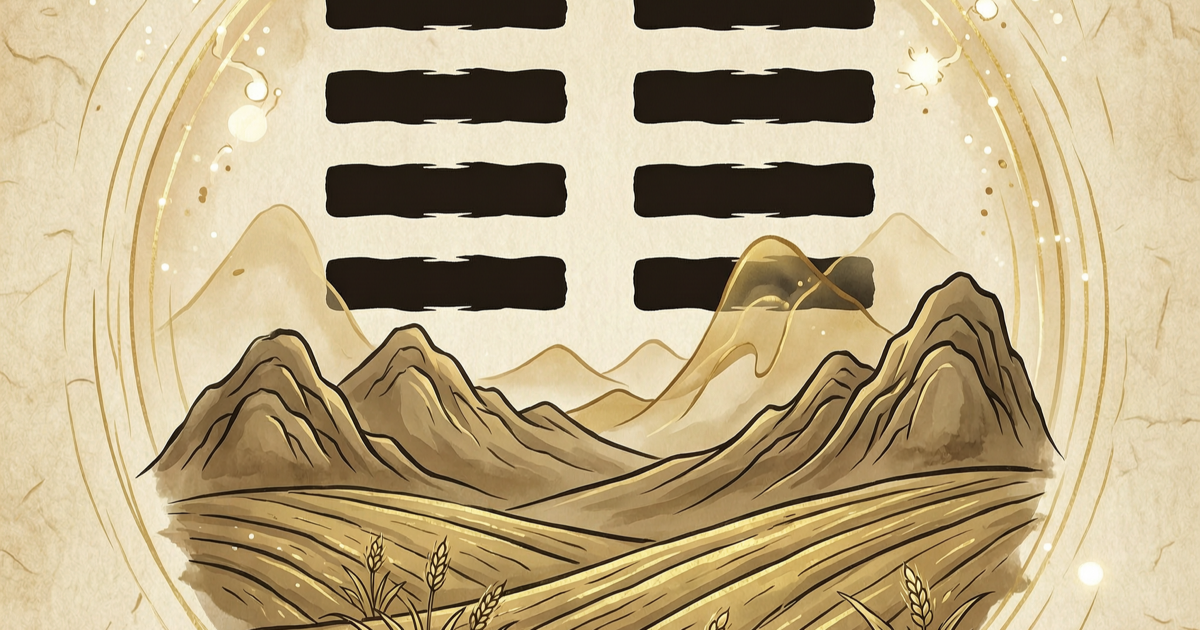
The Kun hexagram is the second hexagram of the 64 hexagrams in the I Ching. Its image is easy to recognize: all six lines are yin lines (six broken horizontal lines). Both the lower and upper trigrams are 'Kun,' symbolizing one word: Earth. If the Qian hexagram (all six yang lines) speaks of Heaven's strength, leadership, and creation, then the Kun hexagram speaks of Earth's gentleness, bearing, cooperation, and accumulation. The most famous phrase, 'The Earth's condition is Kun; the noble person holds the world with thick virtue,' comes from here, meaning: The noble person should emulate the Earth's thick and broad capacity to bear all things.
To put it plainly, the Kun hexagram does not teach you to be weak and retreat, but rather a way of living that 'overcomes hardness with gentleness and wins through accumulation': Do not rush to be the first to charge forward, but be able to steadily catch things and slowly nurture them. It is not opposed to the Qian hexagram, but a complementary pair of yin and yang, indispensable to each other.
Try your own BaZi reading
Get an AI-powered personalized BaZi analysis from your birth info.
Start free analysis1. The Image of the Kun Hexagram: All Six Yin Lines, Pure 'Earth'
To understand the Kun hexagram, first look at what it looks like.
All hexagrams in the I Ching are formed by stacking two types of symbols: 'yin lines' and 'yang lines':
- Yang line
⚊: A continuous horizontal line, representing strength, movement, and advance. - Yin line
⚋: A broken horizontal line, representing gentleness, stillness, and bearing.
The Kun hexagram has all six yin lines from bottom to top, making it the 'purest yin' among the 64 hexagrams. Its lower trigram is Kun (☷ Earth), and its upper trigram is also Kun (☷ Earth), so it is also called 'Kun is Earth.'
| Hexagram | Symbol | Nature | Quality |
|---|---|---|---|
| Qian ☰ | Three yang | Heaven | Strong, leading, creative |
| Kun ☷ | Three yin | Earth | Gentle, bearing, cooperative |
Just remember one tip: All yang is Heaven (Qian), all yin is Earth (Kun). The other six hexagrams (Zhen, Xun, Kan, Li, Gen, Dui) are 'intermediate states' between Heaven and Earth, with varying amounts of yin and yang. Qian and Kun are the parents; the other six are their children—this is the microcosm of the I Ching's 'Heaven and Earth give birth to all things.' For this reason, the Qian and Kun hexagrams are called the 'gate of the I Ching,' the two keys to understanding the entire book.
2. The Hexagram Statement: What Does 'Supreme Success, Favorable for the Mare's Perseverance' Mean?
The hexagram statement of Kun is:
Kun: Supreme success. Favorable for the mare's perseverance. The noble person has somewhere to go. At first confused, later gains a master. Favorable. Gain friends in the southwest, lose friends in the northeast. Peaceful perseverance brings good fortune.
Let's break it down sentence by sentence—it's actually quite practical:
'Supreme success' — Great and penetrating. Like Qian, Kun possesses the energy of 'origin' (yuan) and 'penetration' (heng). The Earth can give birth to and nurture all things, which itself is a pattern of great good fortune.
'Favorable for the mare's perseverance' — This is the finishing touch of the Kun hexagram. 'Mare' is a female horse. Why not a dragon or a stallion, but specifically a mare? Because the mare has two qualities: it can run (as strong as a stallion), but its temperament is gentle (follows, does not rush ahead). This is the spirit of Kun—having strength and ability to act, but taking the path of 'following and bearing,' not vying to be the leader. 'Perseverance' means upholding correctness and persistence. Together, it means: It is most favorable to hold to the duty of 'gentle yet firm.'
'At first confused, later gains a master' — If a person rushes to lead (usurping Qian's position), they will lose direction; knowing how to step back, follow the right master, and cooperate with the overall situation, they will instead gain benefit. This is the life advice given by the Kun hexagram: Not every position requires you to create; find the right role of 'bearing,' and you can still achieve great things.
'Gain friends in the southwest, lose friends in the northeast' — The southwest belongs to yin, a place where similar kinds gather (gain friends, gain support); the northeast belongs to yang, going there will 'lose friends.' This layer was later interpreted as: People must know how to leverage power in the right environment and the right group.
'Peaceful perseverance brings good fortune' — Be at peace with the right path, hold to your duty, and good fortune follows.
The core of the entire hexagram statement is actually eight words: Gentle, upright, cooperative, far-reaching.
3. The Most Famous Phrase: 'The Earth's Condition is Kun; the Noble Person Holds the World with Thick Virtue'
This phrase comes from the Great Image Commentary of the Kun hexagram and is one of the most quoted I Ching sentences in all of Chinese culture (Tsinghua University's motto 'Strive unceasingly, hold the world with thick virtue' takes one phrase from each of the Qian and Kun hexagrams).
The Image says: The Earth's condition is Kun; the noble person holds the world with thick virtue.
'The Earth's condition is Kun' — The Earth's terrain is flat, spread out, and low-lying. It does not compete for height, yet it bears mountains, rivers, seas, and all living creatures.
'The noble person holds the world with thick virtue' — Seeing this hexagram image, the noble person learns: Use deep and broad virtue to bear and accommodate people and affairs.
The key here is 'holds the world.' The reason the Earth can bear everything is not through strength, but through capacity—it is wide enough, thick enough, and low enough, so it can receive and transform both the dirty and the clean, the good and the bad. The lesson of the Kun hexagram for modern people lies here: True bearing comes from the thickness of virtue, not the height of means. How much a person can bear and how many people they can accommodate often determines how far they can go.
4. The Six Line Statements: Reading the Life Script of the Kun Hexagram Line by Line
The Kun hexagram has all six yin lines, which repeatedly discuss 'how to correctly practice gentleness and bearing' from six different positions and stages. Read from bottom (first) to top (sixth):
First Six: Treading on frost, solid ice arrives. When you step on frost, you know that the days of solid ice are not far off. This is the first line of Kun, speaking of seeing the subtle and knowing the obvious—the power of yin accumulates slowly; seeing small signs, one must be alert to the larger trend behind them. Gentleness does not equal slowness; knowing how to read the signs early is true skill.
Second Six: Straight, square, great. Without practice, nothing is unfavorable. Upright, square, and broad. This is the best line of Kun, representing the ideal virtue of the Earth: a straight heart, square conduct, and a broad mind. Achieving these three points, there is no need to deliberately learn any techniques ('without practice'), and naturally everything goes smoothly. The highest state of Kun is to perfect one's duty, not to play tricks.
Third Six: Containing brilliance, one can be steadfast. Perhaps engaging in the king's affairs, without achievement but with completion. Hide your brilliance ('containing brilliance'), and remain steadfast while waiting. Even when doing things or assisting a superior, it is 'without achievement but with completion'—do not take credit, do not vie for the name of achievement, but be able to complete things from start to finish. This is the wisdom of the cooperator: Achievement need not be mine, but I am responsible for finishing the matter.
Fourth Six: Tying the bag. No blame, no praise. Tie the bag tightly ('tying the bag'), meaning when it is time to restrain and keep silent, do so. In sensitive times, do not advance rashly or speak too much; although you may not receive praise, you will not invite disaster. The Kun hexagram acknowledges: In some stages, 'not making mistakes' is itself the best strategy.
Fifth Six: Yellow lower garment. Supreme good fortune. This is the most auspicious line of Kun. 'Yellow' is the central color, the correct color of the Earth, symbolizing occupying the center and upholding correctness; 'lower garment' is the clothing of the lower body, symbolizing being low and humble. When a person's ability reaches a high position (the fifth is the honored position), yet they still remain centered, low, and unassuming, this is called 'yellow lower garment'—great good fortune. The wisdom of Kun reaches its peak here: Being in a high position yet able to be humble is true nobility.
Top Six: Dragons fight in the wild. Their blood is black and yellow. When yin reaches its extreme (the top line of Kun), things reverse. 'Dragon' is originally a symbol of yang; here, yin is so strong that it actually contends with yang, fighting in the wilderness, and both sides are injured ('their blood is black and yellow'; black is Heaven's color, yellow is Earth's). This is the warning of the Kun hexagram: If gentleness goes too far and becomes suppression and contention, it will instead bring conflict. Yin and yang must be balanced; any extreme on either side brings disaster.
Looking at the six lines together, the Kun hexagram actually draws a complete curve: From reading signs (first six) → upholding correctness and being broad (second six) → hiding brilliance and finishing (third six) → knowing when to hold back (fourth six) → being high yet humble (fifth six) → extreme leads to misfortune (top six). It does not teach blind retreat, but to grasp the measure of 'gentleness' at every position.
5. The Life Lessons of the Kun Hexagram: Gentleness, Cooperation, Accumulation
Understanding the hexagram image and line statements, the three lessons of the Kun hexagram for modern people become clear:
1. Gentleness is not weakness; it is the wisdom of 'overcoming hardness with gentleness.' The mare can run; the Earth can bear—behind gentleness is strength, just not revealed or prioritized. Often, being able to catch and bear is harder and more precious than rushing ahead.
2. Learn to be a 'cooperator,' and you can still achieve great things. 'At first confused, later gains a master' and 'without achievement but with completion' both say the same thing: Not every position requires you to lead. Finding the right role to bear, fill in, and finish is a severely underestimated ability. In a team, the person who can steadily bring things to completion is often the true anchor.
3. Believe in the power of accumulation. The Earth does not compete for the moment, yet all things grow from it. The good fortune in the Kun hexagram is almost always tied to 'upholding correctness, peaceful perseverance, and completion'—it rewards compound interest over time, not overnight success. This is also where it most opposes 'quick fixes.'
6. Contrasting Qian and Kun: Between Heaven and Earth, Neither Is Dispensable
Finally, place Qian and Kun together to truly understand the Kun hexagram.
| Qian Hexagram ☰ | Kun Hexagram ☷ | |
|---|---|---|
| Image | All six yang lines | All six yin lines |
| Symbol | Heaven | Earth |
| Quality | Strong, leading, creative | Gentle, bearing, cooperative |
| Famous phrase | Heaven moves strong; the noble person strives unceasingly | Earth's condition is Kun; the noble person holds the world with thick virtue |
| Animal image | Dragon | Mare (female horse) |
| Life role | Creator, leader | Bearer, fulfiller |
Qian and Kun are not about superiority or inferiority, but a complementary cycle: Heaven creates, Earth bears; Yang acts, Yin fulfills. For something to succeed, there must be someone who dares to start (Qian) and someone who can bring it to completion (Kun). Within a single person, both energies are needed—charge like Qian when it's time to rush, and hold like Kun when it's time to stay.
The I Ching places Qian and Kun as the first two hexagrams to tell you: The world operates between 'strength' and 'gentleness,' 'advance' and 'bearing.' Understanding the Kun hexagram means understanding that 'strength is not only about rushing ahead.'
Conclusion: Apply the Wisdom of 'Earth' to Yourself
The logic of yin-yang bearing in the Kun hexagram does not only live in ancient books—it shares the same yin-yang and five-element foundational system with BaZi fortune analysis. The Heavenly Stems, Earthly Branches, and the strengths and weaknesses of the five elements in your birth chart are the specific version of 'how yin and yang are distributed in you.'
Try your own BaZi reading
Get an AI-powered personalized BaZi analysis from your birth info.
Start free analysis