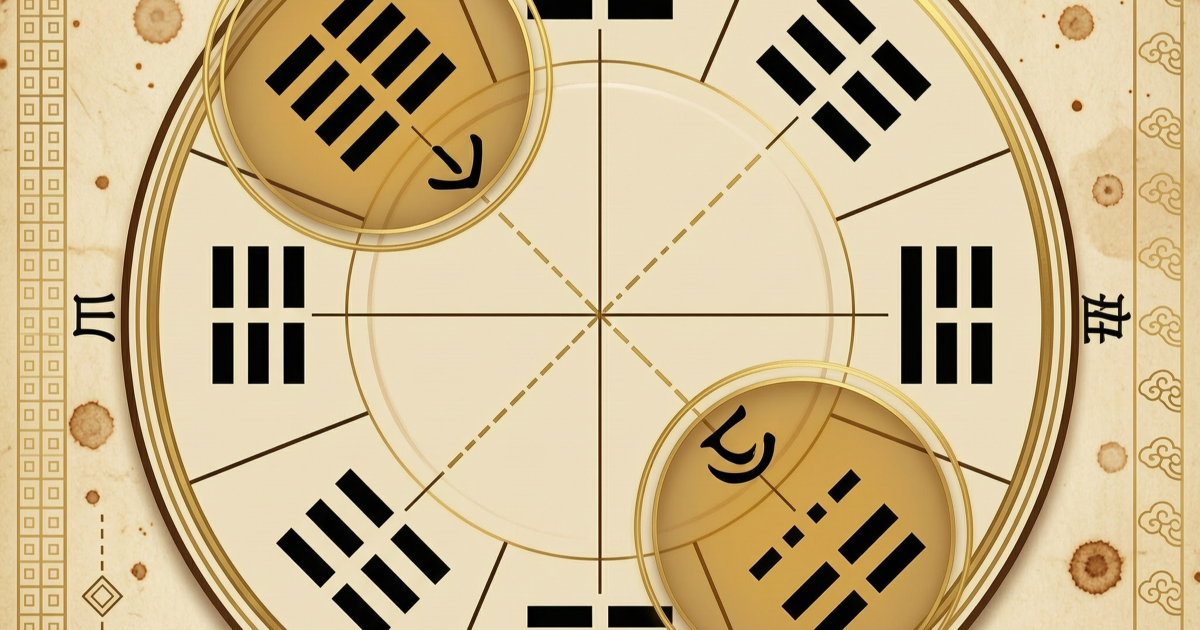
The first time you open the I Ching and see those 64 symbols made of stacked lines, almost everyone feels dizzy: how on earth do you read these lines? Do you have to memorize all 64 hexagrams one by one?
No. The 64 hexagrams are actually formed by stacking just 8 basic trigrams (八卦) in pairs. Once you learn to identify 'which trigram is on top and which is on the bottom,' you can break down and read even the most complex hexagram. This article explains the logic in the simplest terms so you can grasp it all at once.
Try your own BaZi reading
Get an AI-powered personalized BaZi analysis from your birth info.
Start free analysisFirst, the Bottom Line: 64 Hexagrams = 8 Trigrams × 8 Trigrams
The hexagrams of the I Ching are built from 'Yin lines' (broken lines ⚋) and 'Yang lines' (solid lines ⚊).
- Three lines stacked form a → trigram (also called 'basic trigram'), 8 in total.
- Two trigrams stacked (six lines) → hexagram (also called 'double trigram' or 'compound trigram'), 8 × 8 = 64.
So every six-line hexagram you see can be split into upper and lower halves: the bottom three lines form one trigram, and the top three lines form another. The first step in reading a hexagram is always to break it into its upper and lower trigrams.
Step One: Memorize the 8 Trigrams
The trigrams are the foundation. Once you know these 8, all 64 hexagrams become clear. Each trigram is associated with a natural image:
| Trigram | Symbol | Nature | Keywords |
|---|---|---|---|
| Qian ☰ | Three Yang | Heaven | Strength, leadership, initiative |
| Dui ☱ | Open at top | Lake | Joy, speech, communication |
| Li ☲ | Hollow in middle | Fire | Brightness, attachment, civilization |
| Zhen ☳ | Bowl facing up | Thunder | Movement, action, impulse |
| Xun ☴ | Broken at bottom | Wind | Penetration, infiltration, gentleness |
| Kan ☵ | Full in middle | Water | Danger, flow, wisdom |
| Gen ☶ | Bowl overturned | Mountain | Stillness, stability, obstruction |
| Kun ☷ | Three Yin | Earth | Yielding, receptivity,包容 |
The ancients left a mnemonic to help remember the symbols: 'Qian three connected, Kun six broken; Zhen like a bowl up, Gen like a bowl down; Li hollow in middle, Kan full in middle; Dui open at top, Xun broken at bottom.' Recite it while drawing the lines, and you'll memorize it in no time.
Step Two: Upper Trigram is Outer, Lower Trigram is Inner
Once you split the hexagram into upper and lower trigrams, how do you interpret their relationship? Remember one key principle:
- Lower trigram (inner trigram) = inner self, foundation, beginning of the matter.
- Upper trigram (outer trigram) = external environment, trend, development of the matter.
Reading a hexagram means reading 'how I (lower trigram) exist within a certain external environment (upper trigram).' The lower trigram is your foothold, the upper trigram is the situation you face. The 'scene' created by their combination is the message the hexagram conveys about your circumstances.
Step Three: Visualize the 'Scene' of the Two Trigrams Stacked
The most fascinating part is that swapping the same two trigrams produces completely different meanings. Let's use the classic example of 'Water' and 'Fire':
Water over Fire (Completion) (Kan Water above, Li Fire below): Water above, fire below. Fire rises, water flows down—the fire's heat is caught by the water above, and the water is boiled by the fire below. The two forces meet and harmonize; the matter 'has already been accomplished.' 'Completion' means 'already crossed the river.'
Fire over Water (Before Completion) (Li Fire above, Kan Water below): The reverse: fire above, water below. Fire goes up, water goes down—they go their separate ways and never meet. The forces cannot interact; the matter 'has not yet been accomplished.' 'Before Completion' means 'not yet crossed the river'—and this is the last hexagram of the 64, profoundly suggesting that nothing ever truly ends; every ending is a new beginning.
See? Just whether 'water is above fire' or 'fire is above water' creates a world of difference. This is the essence of reading hexagrams—not memorizing the judgment texts, but imagining the scene of the two trigrams stacked together.
A BaZi Perspective: I Ching Reads 'Events,' BaZi Reads 'People'
Many people ask: What's the difference between the I Ching and BaZi? Which one should I learn?
They are actually two tools from the same root that complement each other:
- BaZi reads 'the person'—the Heavenly Stems and Earthly Branches at your birth determine your lifelong elemental pattern, personality, and fortune trends. It is 'destiny,' relatively fixed.
- I Ching (divination) reads 'the event'—a specific matter, a particular moment's situation, whether it's auspicious or not, whether to advance or retreat. It is 'opportunity,' changing with the event.
Yet their underlying language is connected: each trigram has an associated element (Qian and Dui are Metal, Zhen and Xun are Wood, Kan is Water, Li is Fire, Gen and Kun are Earth), which aligns perfectly with BaZi's Five Elements. Someone who understands BaZi will find it easier to grasp the 'elemental flavor' of each hexagram; conversely, someone familiar with the I Ching can better sense the flow of 'timing' in annual cycles.
One tells you 'who you are,' the other tells you 'what to do now.' Using both together is the complete Eastern wisdom.
Final Thoughts
The 64 hexagrams may look intimidating, but once broken down, they are simple: first memorize the 8 trigrams, then learn to see 'upper trigram as outer, lower trigram as inner,' and finally imagine the scene of the two trigrams stacked. Master these three steps, and you'll have the ability to read hexagrams yourself without memorizing judgment texts.
And before you start reading hexagrams or fortunes, getting a clear picture of your own 'person' foundation will make everything more directional.
Try your own BaZi reading
Get an AI-powered personalized BaZi analysis from your birth info.
Start free analysis