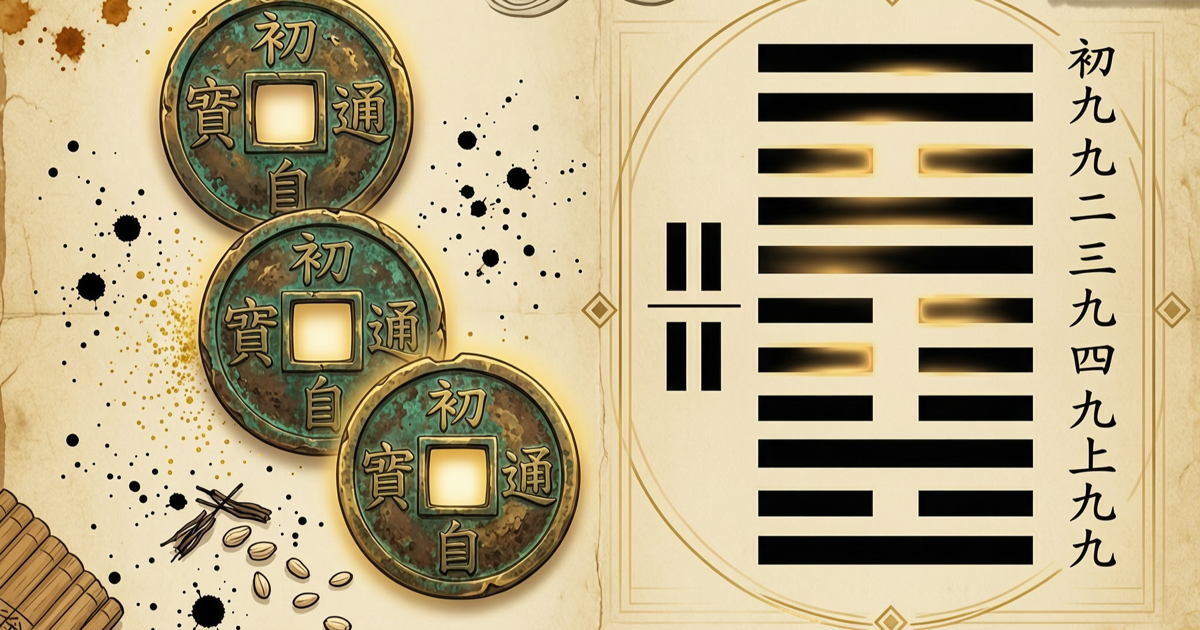
Many people think "divination" means flipping through a book to find the judgment of one of the 64 hexagrams and reading its fortune. But the method actually used for "asking about matters" is something else entirely—Six Yao (六爻). In a nutshell: Six Yao divination uses three coins tossed six times to "install" an abstract hexagram into a chart that can answer specific questions. The key difference from simply looking up a hexagram is that Six Yao assigns Heavenly Stems, Earthly Branches, and the "Six Relatives" to each line, allowing you to ask very specific things: for money, look at "Wealth"; for romance, look at "Officer/Wealth"; for career or lawsuits, look at "Officer"; for documents or elders, look at "Parents."
In other words: reading the 64 hexagrams tells you what a hexagram "looks like"; Six Yao casting turns that hexagram into an instrument that can answer "Will this matter succeed or not?"
Try your own BaZi reading
Get an AI-powered personalized BaZi analysis from your birth info.
Start free analysisFirst, Clarify: What's the Difference Between Six Yao, I Ching Divination, and the 64 Hexagrams?
These three terms are often mixed up, but they refer to three different layers:
- 64 Hexagrams: The "dictionary." Each hexagram has fixed images, judgments, and line texts.
- I Ching Divination: A broad term for "asking the hexagram." Any method (rice, Plum Blossom, coins) yields a hexagram, then you consult the judgment to decide matters.
- Six Yao: The most commonly used divination system, also called Coin Divination, Najia Divination, or King Wen Hexagram. Its feature is—it doesn't just look at the hexagram judgment; it assigns Heavenly Stems, Earthly Branches, Six Relatives, and Self-Responding lines to each line, relying on the interactions (generation and control) between lines to decide specific matters.
So Six Yao's greatest strength isn't "how accurate the hexagram judgment is," but that it breaks a hexagram into six interacting lines that can answer very specific questions. That's why when people ask about money, romance, or daily affairs, they mostly use Six Yao rather than directly consulting the I Ching.
Step 1: How to Toss the Coins? Three Coins, Six Tosses
The tool for Six Yao casting is simple—three coins (if you don't have ancient coins, three identical modern coins work; just decide which side is "heads").
Traditionally, the side with characters is the "face" (heads), and the side without characters is the "back" (tails). Toss once (all three together), count the number of "backs" to determine if the line is Yin or Yang, and whether it moves:
| Result of Three Coins | Name | Line Symbol | Yin/Yang | Moving? |
|---|---|---|---|---|
| One back | Single (單) | ⚊ | Young Yang | No |
| Two backs | Break (拆) | ⚋ | Young Yin | No |
| Three backs | Heavy (重) | ⚊○ | Old Yang | Yes (Yang changes to Yin) |
| Zero backs (three faces) | Cross (交) | ⚋× | Old Yin | Yes (Yin changes to Yang) |
⚠️ Different schools have slight variations on which side counts as Yang. The key is not which system you use, but that you decide beforehand and stay consistent throughout—then there's no confusion.
The order of tossing is crucial: Toss six times, and arrange the lines from bottom to top.
- The 1st toss gives the first line (bottom)
- The 2nd toss gives the second line, the 3rd the third…
- The 6th toss gives the top line (top)
After six tosses, the six lines from bottom to top form a hexagram—this is your original hexagram. The lines that came up as "Heavy" or "Cross" are called Moving lines; they will later generate another hexagram.
Step 2: The Soul of Six Yao—Installing the Six Relatives, Self-Responding Lines, and Moving Lines
If you stop at just "forming a hexagram," it's no different from looking up a hexagram in a book. What makes Six Yao truly powerful is the next step: installing the chart.
① Six Relatives: Which Line Governs Your Question?
Six Yao assigns a "Six Relative" to each line based on the hexagram's Five Element attribute. The Six Relatives are a reference table telling you "for this kind of question, watch this line":
- Wealth (妻財): Money, income, wife, material possessions—for financial luck or business, look here.
- Officer (官鬼): Career, lawsuits, pressure, husband, illness—for career, legal issues, or a woman asking about a romantic partner, look here.
- Parents (父母): Elders, documents, house/car, contracts, education—for exams, signing contracts, buying a house, look here.
- Children (子孫): Juniors, subordinates, pets; also represents "relief from worry, safety"—for health or seeking peace, look here.
- Siblings (兄弟): Siblings, friends, colleagues, competitors—also represents "financial loss, obstacles."
The first step in asking a question is always: "Which Six Relative governs this matter?" That line is your Useful God (用神)—the core line to analyze.
② Self-Responding Lines: Which Line is "Me" and Which is "The Other Party"?
Every hexagram has two fixed marked lines:
- Self Line (世爻) = You, your side, the subject of the inquiry.
- Responding Line (應爻) = The other party, the object, the other end of the matter you're asking about.
For cooperation, look at the generation/control between Self and Responding; for romance, see if they combine. Whether Self and Responding generate/combine or control/clash often determines at a glance the general direction of "success or failure."
③ Moving Lines: The Lines That "Change"—The Turning Point of the Matter
Lines that come up as "Heavy (Old Yang)" or "Cross (Old Yin)" move; movement means change—Yang moves to Yin, Yin moves to Yang. Thus, the original hexagram generates a derived hexagram.
- Original Hexagram (本卦) = The current state of the matter.
- Derived Hexagram (變卦) = The result after development and change.
- Moving Line (動爻) = The key force or turning point that causes this change.
When interpreting, focus on the Useful God line: Is it generated or controlled by a moving line? Does it move itself? Does it change for better or worse? This chain of generation and control is the "answer" given by Six Yao.
Three Core Principles for Casting: Sincerity, Focus, No Doubt No Divination
Six Yao is not about rolling dice for probability. Traditionally, great emphasis is placed on the "state of mind at the moment of casting." Three old rules every beginner must remember:
- One matter per divination: Ask only one question at a time. If you're thinking of three things at once, the resulting hexagram won't know which one to answer, leading to confusion.
- No sincerity, no divination; no doubt, no divination: If your heart isn't sincere, or if you already have an answer and just want the hexagram to back you up—such divinations are the least accurate. Only when you truly have doubt and genuinely want to ask will the hexagram "respond."
- Don't toss repeatedly for the same matter: Tossing again and again because you're unsatisfied with the result is called "insulting the divination." The ancients said, "The first inquiry receives an answer; repeated inquiries are an insult, and the insulted will not answer." Ask too many times, and the hexagram will ignore you.
These may seem superstitious, but they actually protect one thing: forcing you to clarify your question before casting. Just being compelled to articulate "What am I really worried about?" into a clear question often reveals half the answer already.
Six Yao Asks About "Matters," BaZi Looks at "Destiny"—How Do They Work Together?
By now, you can see that Six Yao and BaZi have clear divisions of labor:
- Six Yao: Asks about a specific matter—Will this investment succeed? Will this relationship have a future? Should I take this job? It's a "point."
- BaZi: Looks at the overall pattern and rhythm of a lifetime—What is your innate destiny? Which decade brings what kind of luck? Where are your Wealth, Officer, and Seal? It's a "plane."
The smart way to use them: First use BaZi to understand the big direction of your life (what you favor, what you avoid, when your luck turns), then use Six Yao to ask about the specific matter you're uncertain about at the moment. With the underlying direction correct, your on-the-spot decisions won't be flustered.
Try your own BaZi reading
Get an AI-powered personalized BaZi analysis from your birth info.
Start free analysis