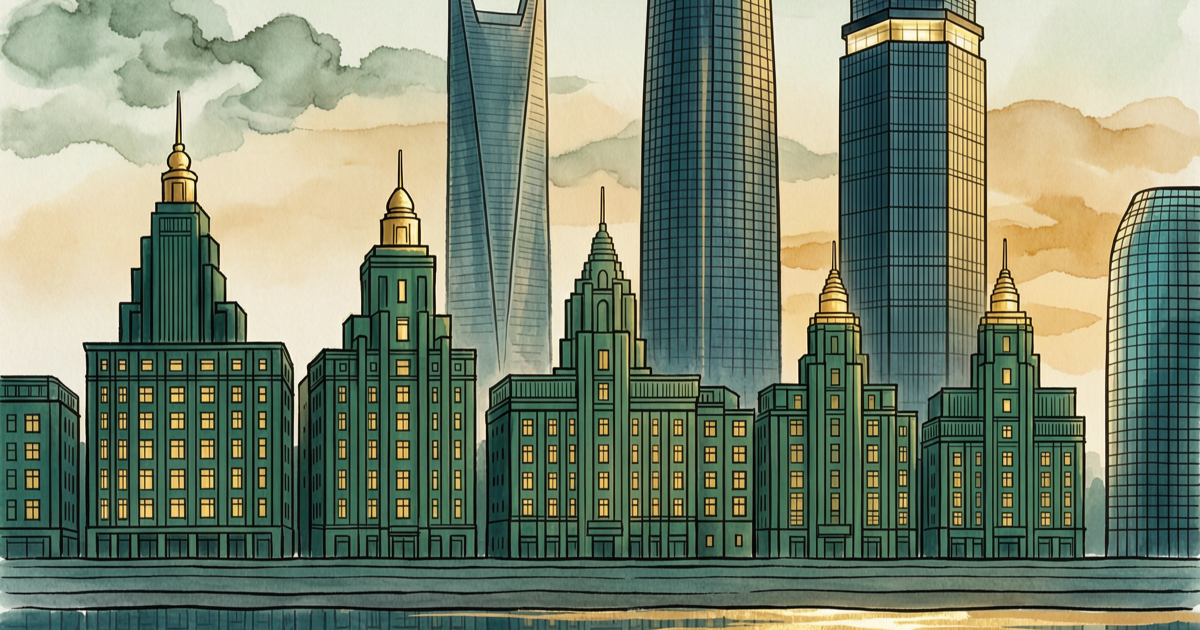
To understand Shanghai's Five Elements (Wu Xing), most people glance at the skyscrapers in Lujiazui and blurt out: Financial center, so it must be Metal.
Metal is indeed one facet of Shanghai. But there is a clue many overlook—its abbreviation is "Shen (申)." And in the twelve Earthly Branches (Di Zhi), "Shen" is Metal; its other abbreviation "Hu (滬)" is steeped in water. A city named "Shen," built on the Huangpu River and the Yangtze estuary, and always pioneering new trends in the East—its Five Elements are actually a cosmopolitan pattern woven from Metal, Water, and Wood.
Here we use the same method from fortune analysis (Ming Li) for reading cities and patterns to unpack Shanghai's Five Elements layer by layer.
Conclusion First
Shanghai's Five Elements form a cosmopolitan city where "Metal is the bones, Water is the veins, and Wood is the innovation."
- Bones are Metal: Shanghai's abbreviation "Shen" corresponds to Metal in the Earthly Branches. It is China's most important financial and commercial center, with steel skyscrapers along the Bund and Lujiazui—this is Metal, governing value, rules, shrewdness, and nobility.
- Lifeline is Water: Shanghai rests on the Yangtze River, faces the East China Sea, and embraces the Huangpu River—a natural river-sea hub. Water governs wealth, flow, trade, and openness—for a century, Shanghai has thrived on its "all rivers flow into the sea" port and commercial waters. Metal generates Water: financial value transforms into ceaseless capital and cargo flows.
- Innovation is Wood: Shanghai is located in East China, leaning east. The East belongs to Wood, governing growth, innovation, and openness. From the "Ten Mile Foreign Concession" to today's fashion, creativity, and internationalization, Shanghai always leads the trend—this drive to "dare to be first and keep growing" is Wood.
In a nutshell: Shanghai is a cosmopolitan metropolis of "White Metal and Clear Water, with Wood energy sprouting. " It is shrewd (Metal), fluid (Water), and trendy (Wood)—three energies interweaving to create that unique "cosmopolitan flair."
Try your own BaZi reading
Get an AI-powered personalized BaZi analysis from your birth info.
Start free analysisStarting from the Abbreviation "Shen": Why Does Shanghai's Five Elements Carry a "Metal" Vibe?
To understand Shanghai's Five Elements, there is a shortcut unique to this city—its abbreviation.
Shanghai is abbreviated as "Shen (申)." And in the twelve Earthly Branches, "Shen" belongs to the Metal element (Shen and You both belong to Western Metal; Shen is Yang Metal). A city's abbreviation is not a strict fortune calculation, but the character "Shen" perfectly aligns with Shanghai's urban character:
- In the Five Elements, Metal governs wealth, value, rules, shrewdness, and nobility;
- Shanghai is China's financial and commercial center—the Bund's international architecture and Lujiazui's skyscraper forest are the most intuitive images of Metal;
- The well-known Shanghai traits of "meticulousness, contract spirit, and rule-following" are precisely the "orderly and precise" nature of Metal.
From the character "Shen" to the city's financial and shrewd temperament, Shanghai has a very hard "Metal" at its core. This is its bones.
The River-Sea Vein: Why Is Shanghai Also a "Water" City?
If Metal is the bone, then Water is Shanghai's bloodline.
Shanghai's other abbreviation is "Hu (滬)," which is inherently related to water (a bamboo fish trap). Its geography is inseparable from water: resting on the Yangtze, facing the East China Sea, with the Huangpu River flowing through—it is the estuary of the Yangtze Economic Belt and one of China's largest port cities.
In the Five Elements, Water governs wealth, flow, trade, openness, and wisdom. The source of all Shanghai's prosperity is precisely this river-sea water:
- It is a natural river-sea hub where goods, capital, and talent converge;
- The phrase "all rivers flow into the sea" is almost Shanghai's city spirit—embracing all without rejection, inclusive and open—this is Water's openness and tolerance;
- When Metal and Water combine, there is a beautiful pattern in fortune analysis called "White Metal and Clear Water"—Metal generates Water, symbolizing pure wealth sources, flowing talent, nobility without turbidity. A city where finance (Metal) drives capital and trade currents (Water) is precisely this clear and noble cycle of "Metal generating Water."
Metal is the bone, Water is the vein, Metal generates Water—this pair supports Shanghai's commercial lifeline.
Try your own BaZi reading
Get an AI-powered personalized BaZi analysis from your birth info.
Start free analysisEastern Wood Energy: Where Does Shanghai's "Newness" Come From?
The most fascinating thing about Shanghai is not just that it has money and does business well, but that it is always "new." And this newness comes from Wood.
Shanghai is located on the eastern coast of China. Relative to the whole country, it sits in the east—the East belongs to Wood, governing growth, innovation, openness, and upward expansion. Wood's nature is to be restless, constantly growing outward and upward. This perfectly explains Shanghai's century-long "trendsetting" character:
- In modern times, it was the "Ten Mile Foreign Concession," the first to embrace Western civilization and the first to be modern and open;
- Today, it is China's fashion, creativity, and internationalization frontier, always chasing the latest trends.
This drive to "dare to be first and seek change" is the energy of Eastern Wood. It prevents Shanghai's Metal (wealth) and Water (flow) from becoming dull and conservative, instead imbuing them with an upward, outward, and innovative thrust. Metal gives it value, Water gives it flow, Wood gives it novelty—the three interweave to create Shanghai's unique cosmopolitan temperament of shrewd pragmatism and modern openness.
How to Determine a City's Five Elements: A Method for Everyone
After reading about Shanghai, you have already mastered a method applicable to any place. To judge a city's Five Elements bias, cross-reference from four angles:
- Look at location and climate: East (growth) leans Wood, South (hot) leans Fire, West (orderly) leans Metal, North (cold) leans Water, Center leans Earth. This is the "environmental Five Elements."
- Look at abbreviation and name: Some cities' abbreviations or nicknames carry Five Elements clues (like Shanghai's "Shen" as Metal, "Hu" near Water).
- Look at industries and character: Finance and systems → Metal, trade and port shipping → Water, innovation and openness → Wood, political power → Earth, technology and culture → Fire.
- Look at historical role: Is the city "shrewd" (Metal), "fluid" (Water), "innovative" (Wood), "stable" (Earth), or "radiant" (Fire)?
Stack these layers, and you see not a simplistic answer like "financial center equals Metal," but a three-dimensional pattern. The same logic applies perfectly to reading your own BaZi—birth season is one layer of environment, while the strength and weakness of the Five Elements and your Favorable God (Yong Shen) are the bones. The latter determines what you truly thrive on, what you lack, and which direction suits you.
Try your own BaZi reading
Get an AI-powered personalized BaZi analysis from your birth info.
Start free analysisFrequently Asked Questions
Q1: Does Shanghai belong to Metal or Water? Both, but with different roles. The bones are Metal (abbreviation "Shen," finance and commerce, shrewdness and rules), the lifeline is Water (river-sea port, all rivers flow into the sea), plus Eastern Wood gives it the drive for innovation. In one sentence: Shanghai is a cosmopolitan city where "Metal is the bones, Water is the veins, and Wood is the innovation. "
Q2: Does Shanghai's abbreviation "Shen" as Metal have a basis in fortune analysis? The abbreviation is a cultural clue, not a strict fortune calculation—but it often aligns closely with the city's character. "Shen" as Metal matches Shanghai's financial, shrewd, and rule-abiding temperament; "Hu" near Water matches its river-sea lifeline. It's best to treat it as an interesting lens for understanding city character, not as a definitive judgment.
Q3: How can knowing a city's Five Elements benefit me? The most practical use is matching: If your BaZi favors Metal and Water (needs wealth, flow, and structure), a city like Shanghai with strong Metal and Water may be especially suitable for your development; if you favor Wood, Fire, or Earth, that's another choice. First figure out your own Five Elements preferences, then compare with the environment—much smarter than blindly following trends.
Conclusion
The answer to "What element does Shanghai belong to?" lies in its name—the abbreviation "Shen" is Metal, "Hu" is Water, and its location in the East is Wood.
Lujiazui's Metal is its bones, the river-sea water is its veins, and Eastern Wood is its ceaseless innovation. White Metal and Clear Water, Wood energy sprouting—these three energies interweave to form the "cosmopolitan" pattern that is the underlying code of this shrewd, fluid, and modern city.
And the same principle is hidden in your own BaZi. Are you a "White Metal and Clear Water" pattern of pure wealth and nobility, or a completely different combination? First understand your own Five Elements, then you'll know which land and which path are best for you to prosper and shine.