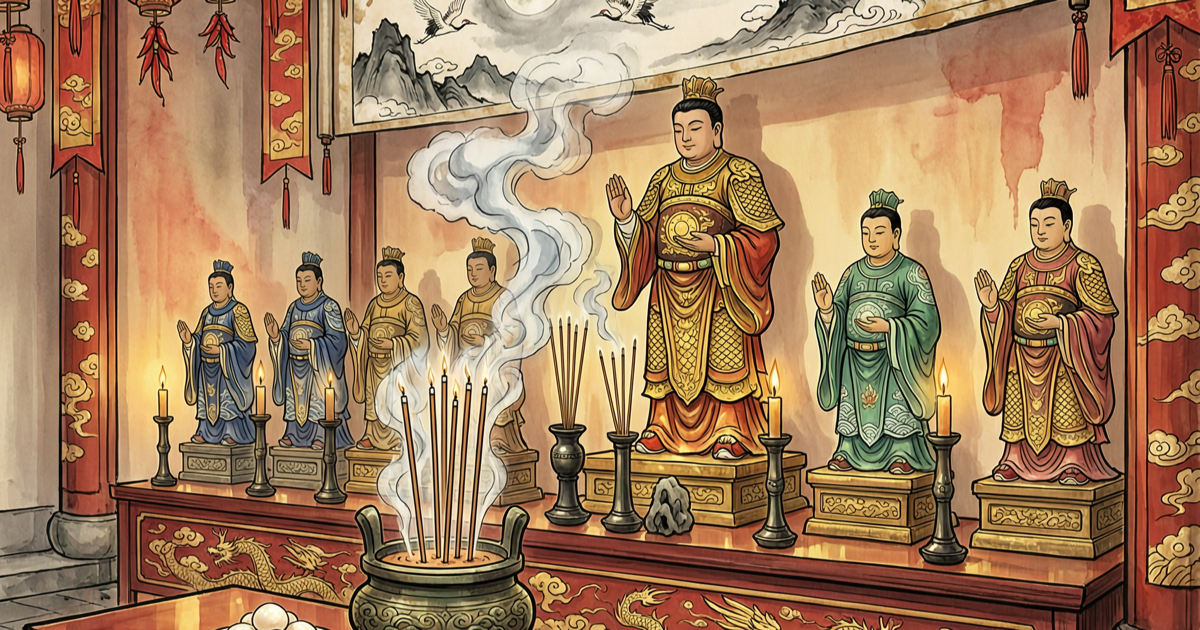
In Chinese folk belief, deities have birthdays all year round. From the Jade Emperor's longevity celebration in the first month to the Moon Elder's sacred birthday around Mid-Autumn, almost every month has a day dedicated to a specific deity. However, most people only remember the 1st and 15th of the lunar month, missing the most auspicious time to offer incense and make wishes on a deity's sacred birthday (聖誕千秋). This article compiles a full-year calendar of major deities' birthdays and, from a BaZi annual cycle perspective, explores why choosing the right day to pray is actually related to your birth chart.
Key Takeaways
Deity birthdays (also called sacred birthdays, thousand autumns, or Buddha's birthday) are commemorative days for various gods and Buddhas in folk belief, almost all calculated according to the lunar calendar. To know which deity to worship today, simply check the lunar date: worship the Jade Emperor on the 9th of the first month, Guanyin Bodhisattva's birthday on the 19th of the second month, Mazu's birthday on the 23rd of the third month, Lord Guan on the 13th of the fifth month, the Ghost Festival on the 15th of the seventh month, the Moon Elder and Lady Taiyin around the 15th of the eighth month... almost every month has a key day. Choosing the right day to pray is not just about following custom; it's about leveraging the deity's "in-season" energy to make your wishes clearer.
As for "which deity is most effective," there is no standard answer – seeking love, visit the Moon Elder; seeking career, worship Wenchang; seeking safety, worship Mazu – it all depends on your wish. A more advanced perspective is: what you wish for often relates to the strength of your annual cycle's Five Elements; understanding what your birth chart lacks and what to supplement, then praying before the corresponding deity, will give you more peace of mind.
Try your own BaZi reading
Get an AI-powered personalized BaZi analysis from your birth info.
Start free analysisWhat Are Deity Birthdays and Why Are They All Based on the Lunar Calendar?
"Deity birthdays" generally refer to the birth anniversaries of various gods, Buddhas, sages, and local guardian spirits. They are called differently in different traditions: Buddhism often calls them "Buddha's birthday," while Taoism and folk belief often call them "sacred birthday" or "thousand autumns" (千秋 originally meant birthday congratulations, later becoming an elegant term for a deity's birthday).
Let's clarify a few commonly confused concepts:
- Almost all are based on the lunar calendar. Chinese traditional festivals and religious activities follow the lunisolar calendar, and deity birthdays are no exception. So the dates you see on the Gregorian calendar change every year – the 23rd of the third lunar month this year will not be the same Gregorian date as last year.
- "Sacred birthday" is not necessarily a historical birthday. Many deities are deified historical figures (such as Lord Guan and Mazu), and many are divine beings in belief. Their "birthdays" are mostly dates passed down by convention from temples and Taoist centers over the centuries, serving as general folk references, not verifiable birth records. It's normal for the same deity's sacred birthday to vary by a day or two between different temples.
- The same deity may have multiple commemorative days. For example, Guanyin Bodhisattva has three important days: sacred birthday (19th of the second month), enlightenment (19th of the sixth month), and renunciation (19th of the ninth month). Devotees often celebrate all three.
Folk belief is fundamentally built on the same Stem-Branch (干支) calendar as BaZi. Each of the twelve Earthly Branches corresponds to a month, and each month has its prevailing Five Element energy. Many deities' sacred birthdays happen to fall in seasons that match their divine attributes. To better understand this temporal logic, you can first read our Earthly Branches introduction to see why Chinese people care so much about "choosing the right day."
Full-Year Deity Birthday Calendar (Lunar Calendar)
The following lists the sacred birthdays of major deities commonly worshipped with strong incense offerings throughout the year. All dates are lunar calendar and serve as general folk references; local temples may vary slightly, so please refer to the announcements of the temple you frequent.
| Lunar Date | Deity | Common Wishes |
|---|---|---|
| 9th of 1st month | Jade Emperor (Heavenly Lord) Longevity | Family safety, annual fortune |
| 15th of 1st month | Heavenly Official of Upper Prime (Lantern Festival) | Blessings, fertility |
| 2nd of 2nd month | Lord of the Earth (Earth God) Birthday | Wealth, local peace |
| 3rd of 2nd month | Wenchang Emperor Birthday | Exams, studies, literary career |
| 19th of 2nd month | Guanyin Bodhisattva Birthday | Peace, compassion, disaster relief |
| 3rd of 3rd month | Xuantian Supreme Emperor Birthday | Exorcism, health |
| 15th of 3rd month | Baosheng Emperor Birthday | Health, medicine |
| 23rd of 3rd month | Heavenly Holy Mother (Mazu) Birthday | Safe travel, navigation, general fortune |
| 8th of 4th month | Shakyamuni Buddha Birthday (Bathing Buddha Festival) | Wisdom, purity, karmic cleansing |
| 14th of 4th month | Lü Dongbin (Fuyou Emperor) Birthday | Wisdom, wealth |
| 13th of 5th month | Lord Guan (Guansheng Emperor) Birthday | Career, integrity, martial wealth |
| 19th of 6th month | Guanyin Bodhisattva Enlightenment | Peace, turning luck |
| 24th of 6th month | King of Western Qin / Thunder Ancestor Birthday | Trade protection |
| 15th of 7th month | Earthly Official of Middle Prime (Ghost Festival) | Salvation, disaster relief, absolution |
| 30th of 7th month | Ksitigarbha Bodhisattva Birthday | Salvation, filial piety |
| 3rd of 8th month | Kitchen God (Siming Zhenjun) Birthday | Household, food safety |
| 15th of 8th month | Lady Taiyin (Moon Goddess) Birthday | Fulfillment, reunion |
| Around 15th of 8th month | Old Man Under the Moon (Moon Elder) Birthday | Romance, relationships |
| 9th of 9th month | Marshal of the Central Altar (Prince Nezha) / Double Ninth Festival | Exorcism, children's safety |
| 19th of 9th month | Guanyin Bodhisattva Renunciation | Purity, making vows |
| 15th of 10th month | Water Official of Lower Prime Birthday | Disaster relief, calamity resolution |
| 17th of 11th month | Amitabha Buddha Birthday | Rebirth, peace |
| 24th of 12th month | Sending Off the Gods Day (gods return to heaven to report) | Thanksgiving, cleaning shrines |
The above table is a general folk reference. Temples and local traditions may vary (for example, the Moon Elder's sacred birthday is set on the 15th of the 8th month in some temples and on other days elsewhere). Please refer to the announcements of your local temple. This article makes no claim about "which day is most effective."
Which Deity to Worship? Match Your Wish
Many people wonder, "I have so many wishes, which deity should I pray to?" In fact, folk belief has a clear division of labor – match your wish to the corresponding deity:
- Seeking love, mending relationships → Old Man Under the Moon, Lady Taiyin. Around Mid-Autumn in the 8th month is when the Moon Elder's energy is strongest.
- Seeking exam success, academic advancement, literary career → Wenchang Emperor. His sacred birthday on the 3rd of the 2nd month sees the heaviest incense during exam season.
- Seeking career, business, integrity → Lord Guan (Guansheng Emperor). Many businesses worship him as the Martial God of Wealth.
- Seeking wealth, local prosperity → Lord of the Earth (Earth God), Martial God of Wealth. Business owners often hold grand ceremonies on the 2nd of the 2nd month ("Head Tooth").
- Seeking safety, disaster relief, resolution → Guanyin Bodhisattva, Mazu, Xuantian Supreme Emperor. These are the most versatile "general fortune" protectors.
- Seeking health, medicine → Baosheng Emperor.
- Seeking family fortune, annual outlook → Jade Emperor (Heavenly Lord). Worshiping the Heavenly Lord on the 9th of the 1st month is the most solemn "new year ceremony" in folk tradition.
Note that worship itself is a form of psychological comfort and making vows. The key is to state your wishes clearly and understand your own state, not to superstitiously believe that "praying to the right deity guarantees results."
Why Choosing the Right Day to Pray Relates to Your BaZi Annual Cycle
This is a perspective that goes beyond the common almanac: what you wish for this year is often hidden in your birth chart.
BaZi emphasizes the balance of the Five Elements – Metal, Wood, Water, Fire, and Earth – which have varying strengths and preferences in a person's chart. The Annual Cycle (Liu Nian) (the Stem-Branch of each year) brings different Five Element energies, influencing the challenges you are most likely to face that year:
- If the annual cycle clashes with your Spouse Palace (Day Branch), relationships may become turbulent – this year is especially suitable for quietly making vows on the sacred birthdays of the Moon Elder or Lady Taiyin, clarifying your expectations for love.
- If the annual cycle brings Ten Gods favorable to your career (such as Executive or Earner in season), it's a good year to advance your career – making vows around the sacred birthdays of Lord Guan or Wenchang Emperor will give you a greater sense of "going with the flow." To understand these terms, first read our Ten Gods introduction.
- Those with a particular Five Element weak in their chart can pay more attention to related matters during the month when that element is in season and around the sacred birthday of the corresponding deity. To understand the strength distribution of your Five Elements, Five Elements introduction is a good starting point.
In other words, the deity birthdays on the almanac are a "standard schedule" for everyone; but which days you should pay special attention to and in which direction you should make vows are personal – this is where your birth chart can help. Instead of blindly praying everywhere, first understand your annual cycle's Five Elements, then choose the corresponding deity's sacred birthday to make your wishes precise.
Basic Worship Etiquette and Timing
Now that you know the dates, here are a few general worship tips (customs vary by region, for reference only):
- Time: Most people choose the morning, especially on the sacred birthday itself; traditionally, periods with stronger yang energy are considered more suitable for offerings.
- Offerings: Vary by deity – for Buddhas, fresh flowers, fruits, and vegetarian food are common; for Taoist and folk deities, you may prepare three meats, wine, pastries, etc. Vegetarian vs. non-vegetarian rules differ by temple; follow the temple's regulations.
- Mindset: State your wishes clearly, provide your name, address, and what you seek. Sincerity is enough; extravagance is unnecessary.
- Worshiping the Heavenly Lord is the most solemn: On the 9th of the 1st month, traditionally preparations begin the night before at the Zi hour (after 11 PM), with an offering table divided into upper and lower levels – it is the most careful ritual of the year.
The most important point: Worship is about making vows and finding peace, not a transaction. It helps you gather your chaotic thoughts into a clear direction. As for the outcome, you must still walk it out in real life.
Frequently Asked Questions
Q: Are deity birthdays based on the lunar or Gregorian calendar? A: The vast majority are based on the lunar calendar, so the corresponding Gregorian date changes every year. Check the current year's almanac or temple announcements for accuracy.
Q: What if multiple deities have birthdays on the same day? A: That's normal. You can choose one or two main deities to worship based on your most important wish, or visit a comprehensive temple and pay respects to all.
Q: Can I still worship if I miss a deity's sacred birthday? A: Of course. The sacred birthday is just the day with the heaviest incense and most attention; you can still offer incense and make wishes on the regular 1st and 15th of the lunar month. Sincerity is what matters.
Q: I don't know what to wish for or which deity to worship. What should I do? A: Start with your birth chart – see what challenges your annual cycle may bring, then match them to the appropriate deity. First, generate a free BaZi birth chart to see your annual cycle's Five Elements; the direction will become much clearer.
Conclusion
This deity birthday calendar is the "faith timeline" for Chinese people throughout the year. Remembering a few key dates allows you to express your wishes at the right time. But what truly makes worship "directional" is understanding yourself first – where your annual cycle is heading, what Five Elements you lack, and what to supplement. With the key of your birth chart in hand, when you make vows before the corresponding deity, you'll find that worship transforms from "following custom" to "going with the flow."
May you meet the right deity on the right day, and make your wishes clearly and thoroughly.