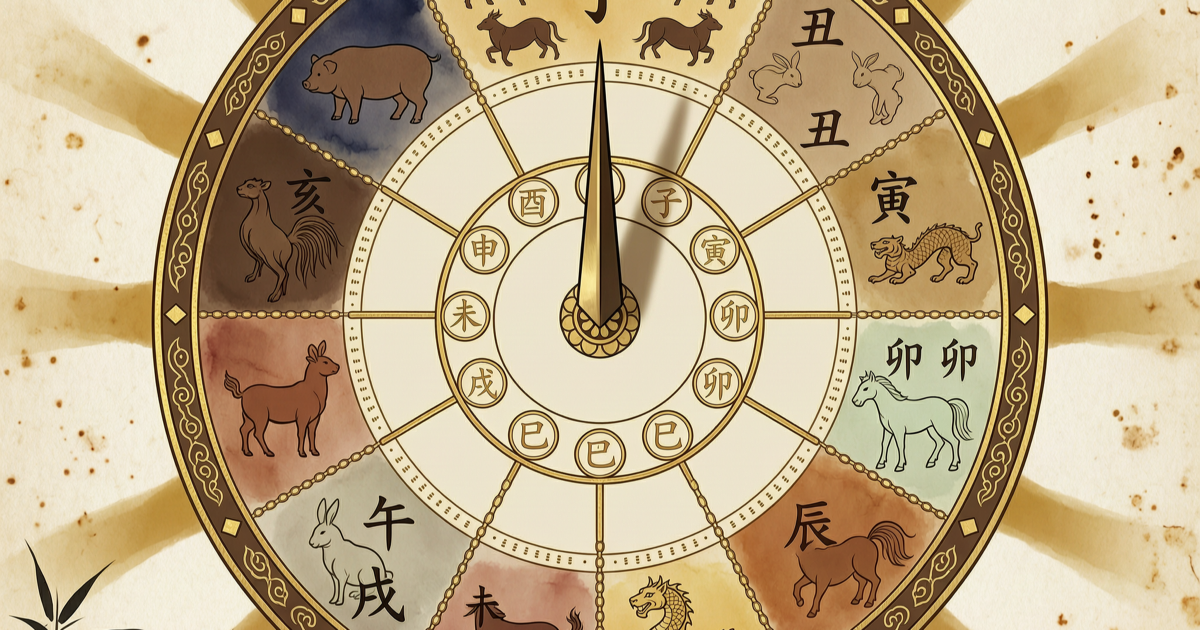
Let's start with the conclusion: The twelve two-hour periods (十二時辰) are the ancient method of dividing a 24-hour day into 12 segments, each 2 hours long—Zi, Chou, Yin, Mao, Chen, Si, Wu, Wei, Shen, You, Xu, Hai. Each period corresponds to one Earthly Branch (Di Zhi) and one zodiac animal. The 2-hour window you were born in determines your Hour Pillar (時柱, the fourth pillar of your birth chart), and the Hour Pillar governs your children, later-life fortune, and the deepest hidden aspects of your personality. This article first provides a complete reference table for self-check, then explains the most error-prone step: "how to convert birth clock time into the Hour Pillar."
Try your own BaZi reading
Get an AI-powered personalized BaZi analysis from your birth info.
Start free analysisBelow, we cover everything from the reference table to an actual birth chart.
Complete Twelve Two-Hour Periods Reference Table (Self-Check Directly)
Match your birth clock time against the table below to find your period:
| Period | Corresponding Time | Zodiac Animal | Alternate Name |
|---|---|---|---|
| Zi (子) | 23:00–01:00 | Rat | Midnight, Third Watch |
| Chou (丑) | 01:00–03:00 | Ox | Cockcrow, Fourth Watch |
| Yin (寅) | 03:00–05:00 | Tiger | Dawn, Fifth Watch |
| Mao (卯) | 05:00–07:00 | Rabbit | Sunrise |
| Chen (辰) | 07:00–09:00 | Dragon | Meal Time |
| Si (巳) | 09:00–11:00 | Snake | Mid-Morning |
| Wu (午) | 11:00–13:00 | Horse | Noon, Midday |
| Wei (未) | 13:00–15:00 | Goat | Afternoon |
| Shen (申) | 15:00–17:00 | Monkey | Late Afternoon |
| You (酉) | 17:00–19:00 | Rooster | Sunset |
| Xu (戌) | 19:00–21:00 | Dog | Dusk |
| Hai (亥) | 21:00–23:00 | Pig | Quiet Hour |
Three key points to remember first:
- Each period is 2 hours, starting at an odd-numbered hour (Zi is an exception, starting at 11 PM).
- Does an "on-the-hour" time belong to the previous or next period? For example, if born at 13:00, is it Wu or Wei? The general rule is that the on-the-hour time belongs to the following period—13:00 starts Wei. But if you're within a minute or two of the boundary, it's recommended to try both when generating your chart and see which fits better.
- The times in the table are clock time, but BaZi actually uses True Solar Time—this is the step most people get wrong, explained in detail below.
How to Convert Birth Clock Time into the "Hour Pillar"?
Knowing the period is not enough. The Hour Pillar in BaZi consists of two characters: a Heavenly Stem (Tian Gan) and an Earthly Branch (Di Zhi). The Earthly Branch is directly determined by the period (e.g., Wei period gives the branch "Wei"), but the Heavenly Stem is derived from your Day Master (日主) through a rule called the "Five Rat Escape" (五鼠遁).
The good news: You don't need to memorize it. Let the chart calculation tool handle it—it will compute the Hour Pillar's Heavenly Stem in seconds. What you really need to pay attention to is the following step most likely to cause the entire Hour Pillar to be miscalculated—
Key: Use True Solar Time, Not Your Phone's Time
BaZi looks at "where the sun is in the sky," but our clock time is based on artificial time zones, and the two can differ significantly.
- Time Zone Difference: Taiwan, Hong Kong, and all of mainland China use the same East Eight Zone standard time, but actual longitudes vary. The time when the sun is directly overhead differs. The farther west you are (e.g., Chengdu, Chongqing), the more True Solar Time lags behind clock time—potentially by over 40 minutes.
- Consequence: If you were born around 15:00, your clock time says Shen period, but after converting to True Solar Time, you might still be in Wei period—the entire Hour Pillar changes.
So if you were born near a period boundary, you must correct for longitude. A reliable chart calculation tool will ask for your birth location and automatically correct for True Solar Time—no manual calculation needed.
The "Early/Late Zi" Debate: Does 23:00–24:00 Count as Today or Tomorrow?
This is the only point of contention among the twelve periods, and it's also the easiest way to miscalculate the Day Pillar.
The Zi period spans midnight (23:00–01:00), so it's split into two halves:
- Late Zi / Night Zi (晚子時 / 夜子時): 23:00–24:00, still on the same day.
- Early Zi (早子時): 00:00–01:00, past midnight.
The debate: If born at 23:30, does the Day Pillar count as today or tomorrow? There are two schools of thought in fortune analysis:
- Majority view (day changes at Zi start): Once 23:00 hits and Zi begins, the Day Pillar jumps to the next day.
- Minority view (Night Zi): The day changes only at midnight 00:00; 23:00–24:00 still uses today's Day Pillar, just with the Zi period branch.
The Day Pillar calculated by the two schools can differ by one day, and the Day Pillar determines your Day Master (the core of the chart). So if you were born between 11 PM and early morning, make sure to check which rule your tool uses, and if necessary, generate both versions for comparison.
What Does the Hour Pillar Reveal in a Birth Chart?
Now that you know how to convert, let's discuss what the Hour Pillar "does." The four pillars of BaZi each govern a stage of life, and the Hour Pillar, being the last, mainly looks at three things:
- Later-Life Fortune: The Hour Pillar represents circumstances after age 55—whether old age is stable and blessed.
- Children Palace: Traditionally, the Hour Pillar indicates the fate of children and the depth of your relationship with them.
- Hidden Personality: Compared to the Year, Month, and Day Pillars, which show the "external you," the Hour Pillar is often interpreted as your inner, private, and concluding side.
So getting the period wrong doesn't just mean missing one pillar—it means the entire interpretation of later-life fortune and children fate is skewed. This is why BaZi places such importance on accurate birth time.
Practical Example: Walking Through "Period → Hour Pillar" for a Chart
Rules alone can feel abstract, so let's actually generate a chart. Below is a sample birth chart (a teaching example with a fictional birth date, not a real person):
Male (乾造): Born March 15, 1991, at 14:30 in Shanghai · Jia Wood Day Master
14:30 falls within 13:00–15:00, which according to the table is the Wei period, so the Earthly Branch is "Wei"; then, using the Five Rat Escape from the Jia Wood Day Master, the Heavenly Stem is derived as "Xin"—so the Hour Pillar is Xin Wei (辛未).
| Year Pillar | Month Pillar | Day Pillar | Hour Pillar | |
|---|---|---|---|---|
| Heavenly Stem | Xin | Xin | Jia | Xin |
| Earthly Branch | Wei | Mao | Shen | Wei |
| Ten Gods | Executive (正官) | Executive (正官) | Day Master | Executive (正官) |
| Nayin | Earth by the Roadside (路旁土) | Pine and Cypress Wood (松柏木) | Water in the Spring (泉中水) | Earth by the Roadside (路旁土) |
| Hidden Stems | Ji, Ding, Yi | Yi | Geng, Ren, Wu | Ji, Ding, Yi |
Five Elements Score: Metal 38%, Wood 25%, Earth 22%, Fire 10%, Water 5%
Look at this Hour Pillar "Xin Wei": the Heavenly Stem Xin Metal is an Executive (正官), and the Earthly Branch Wei hides Ji, Ding, and Yi. For a Jia Wood Day Master, the Executive appearing in the Hour Pillar is traditionally interpreted as "later life emphasizes rules, strict with children, and ends with propriety." The key point is—this pillar is Xin Wei and not something else solely because of the "Wei period." If the period had been entered as Shen (after 15:00), the entire Hour Pillar would change, and this interpretation would be completely different. That's why the period must be accurately determined.
Three Most Common Traps
Trap 1: Using your phone's time directly as the period. Your phone shows the time zone standard time, not True Solar Time. If you were born near a period boundary (around each even hour, before/after odd hours), failing to correct for longitude can miscalculate the entire Hour Pillar. Fill in your location and let the tool auto-correct—don't skip this step.
Trap 2: Born after 11 PM, not clarifying which day the Day Pillar belongs to. The Zi period spans midnight. For those born between 23:00–24:00, the Day Pillar could be today or tomorrow—a one-day difference changes the Day Master. When generating your chart, confirm the rule used; if unsure, generate both versions and see which fits you better.
Trap 3: Not knowing the exact period and filling in a random one. If the Hour Pillar is wrong, the interpretation of later-life fortune and children fate is completely skewed. If you truly don't know the period, it's better to use just the three pillars (year, month, day) than to fill in a fake period—false data is more misleading than missing data. Many people eventually recover the period by asking elders or checking birth certificates.
Accurate Period Determination Makes the Birth Chart Reliable
Back to the beginning: The twelve two-hour periods are a timekeeping method dividing a day into 12 segments of 2 hours each. The 2 hours you were born determine the Hour Pillar—and the Hour Pillar governs later life, children, and your innermost self.
The reference table helps you find "which period," but the real pitfalls to watch out for are clock time ≠ True Solar Time and the Zi-period cross-day conversion traps. Get the period right, fill in the location correctly, and the Hour Pillar will be solid, allowing the second half of your birth chart to be interpreted accurately.
Try your own BaZi reading
Get an AI-powered personalized BaZi analysis from your birth info.
Start free analysis