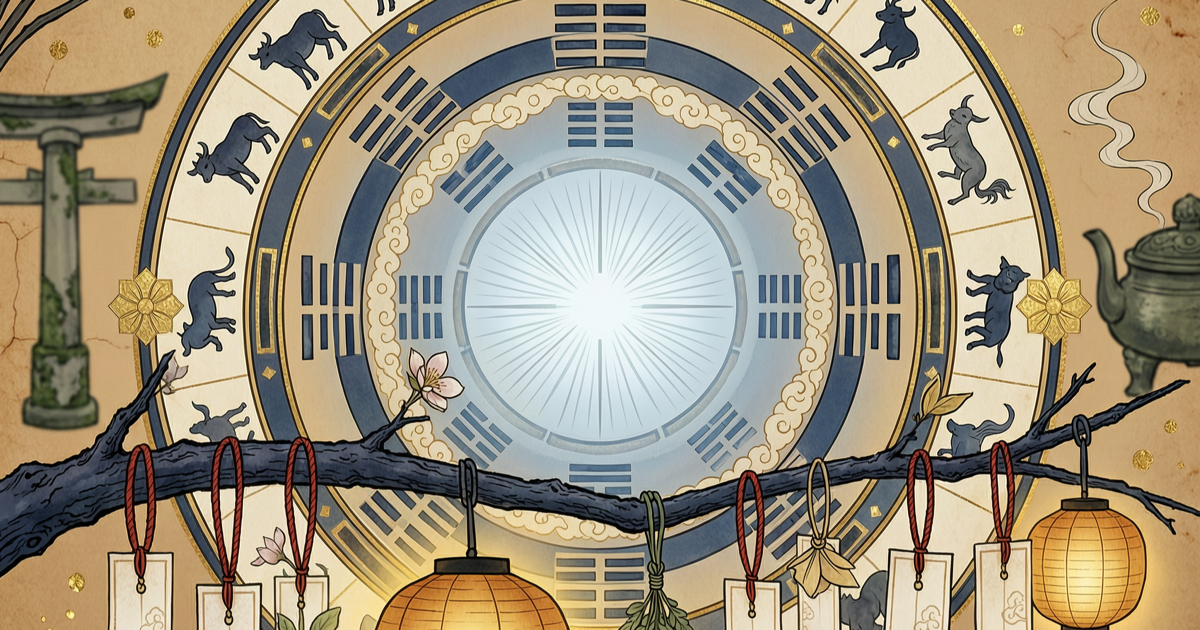
What is the most popular fortune-telling in Japan? Not Tarot, not Western astrology. It's a fortune-teller named "Getter's Iida" — his "Five Star Three Heart Divination" has long dominated bestseller lists, having assessed over 70,000 people. But few know: this fortune-telling that has addicted all of Japan is actually, at its core, the BaZi most familiar to us Chinese.
First, the Conclusion: The Roots of Japanese People's Favorite Fortune-Telling Are All BaZi
Several major fortune-telling methods popular in Japan are almost all variations of BaZi (called "Four Pillars Fortune-Telling" in Japan):
- Five Star Three Heart Divination (Getter's Iida): A fusion of Four Pillars Fortune-Telling, Western astrology, and nameology, dividing people into 120 types
- Celestial Star Technique (Hoshi Hitomi): An improved version of Eastern calendar plus statistics
- Animal Fortune-Telling: Directly takes the twelve life stages of Four Pillars Fortune-Telling and turns them into cute animal characters
In other words, the "trendy fortune-telling" that Japanese people have been playing for decades has its roots in an ancient Chinese fortune-telling system from the Song Dynasty. You think you're playing with the trendiest thing, but you're actually touching the hem of a thousand-year-old classic.
Try your own BaZi reading
Get an AI-powered personalized BaZi analysis from your birth info.
Start free analysis"Four Pillars Fortune-Telling" Is BaZi
"Four Pillars Fortune-Telling" is the Japanese term; Chinese call it BaZi or Zi Ping. It's the same system:
Using the year, month, day, and hour of birth to arrange four pillars (Four Pillars), each pillar has one Heavenly Stem plus one Earthly Branch, two characters, totaling exactly eight characters — hence the name "BaZi." By examining the strength of the Five Elements (Wood, Fire, Earth, Metal, Water) in these eight characters and the generating and overcoming relationships among the Ten Gods, one can deduce a person's personality, talents, and fortune trends.
Japanese call the birth chart "Meishiki," the Ten Gods "Tsūhensei," and the Day Master "Nikkansu" — different names, but the core is exactly the same.
Why Are Japanese People More Obsessed with Four Pillars Fortune-Telling Than Chinese?
Interestingly, BaZi is often labeled as "superstition" in Chinese communities, but in Japan, it is revered as "authentic, accurate statistics" with high status.
After being systematically organized by people like Abe Taizan, Four Pillars Fortune-Telling became the "hardcore foundation" of the fortune-telling world. The cost: high barrier, difficult to self-study. Ordinary people can't understand terms like Hidden Stems, Patterns, and Useful Gods, so Japanese simply invented simplified entry points like Five Star Three Heart and Animal Fortune-Telling, allowing those unfamiliar with fortune-telling to get a taste.
In essence, the popularity of Five Star Three Heart Divination is precisely because Four Pillars Fortune-Telling is too difficult — it built a cable car for the masses up a high mountain.
Popular Fortune-Telling vs. Four Pillars Fortune-Telling: What's the Difference
| Fortune-Telling Method | Accuracy (Authenticity) | Depth | Ease of Learning |
|---|---|---|---|
| Four Pillars Fortune-Telling (BaZi) | ★★★★★ | Very deep | High (requires professional knowledge) |
| Five Star Three Heart Divination | ★★★★☆ | Medium (typing) | Low |
| Western Astrology | ★★★☆☆ | Medium | Low |
| Tarot | ★★★☆☆ | Shallow to Medium | Very low |
The reason BaZi is "deep" is that it uses even the hour of birth, and the Stem-Branch combinations of the four pillars and eight characters can reveal countless layers of detail; while typing fortune-telling methods cram billions of people into a dozen or a hundred boxes, inevitably only giving a general direction. The difference in accuracy lies here.
AI Has Dismantled the Wall of "Difficulty"
The problem with Four Pillars Fortune-Telling has never been "whether it's accurate," but "too difficult, too expensive." In the past, to get an accurate birth chart and a decent interpretation, you had to find a master, spend a lot of money, and wait in line.
Now AI has dismantled this wall. Shunshi's AI BaZi, by inputting your birth date and time, can:
- Automatically generate an accurate birth chart (Meishiki)
- Instantly analyze Five Element strengths and Ten God patterns
- Explain each conclusion in jargon-free plain language
- Even chat with you, answering any questions until you understand
The "authentic Four Pillars Fortune-Telling assessment" that Japanese people envy and have to pay fortune-tellers to get, you can now play with for free, in Chinese, while chatting and calculating.
Conclusion
- Japan's hottest Five Star Three Heart Divination, Celestial Star Technique, and Animal Fortune-Telling all originate from BaZi (Four Pillars Fortune-Telling)
- BaZi is a "accurate but difficult" hardcore fortune-telling system; typing fortune-telling is just its simplified entry point
- AI has reduced the barrier to zero — you don't need to understand jargon to read your own birth chart
Next time a Japanese friend gets excited talking about fortune-telling, you can calmly say: This? Our ancestors were already playing it a thousand years ago. Then, casually generate your own birth chart to show them.