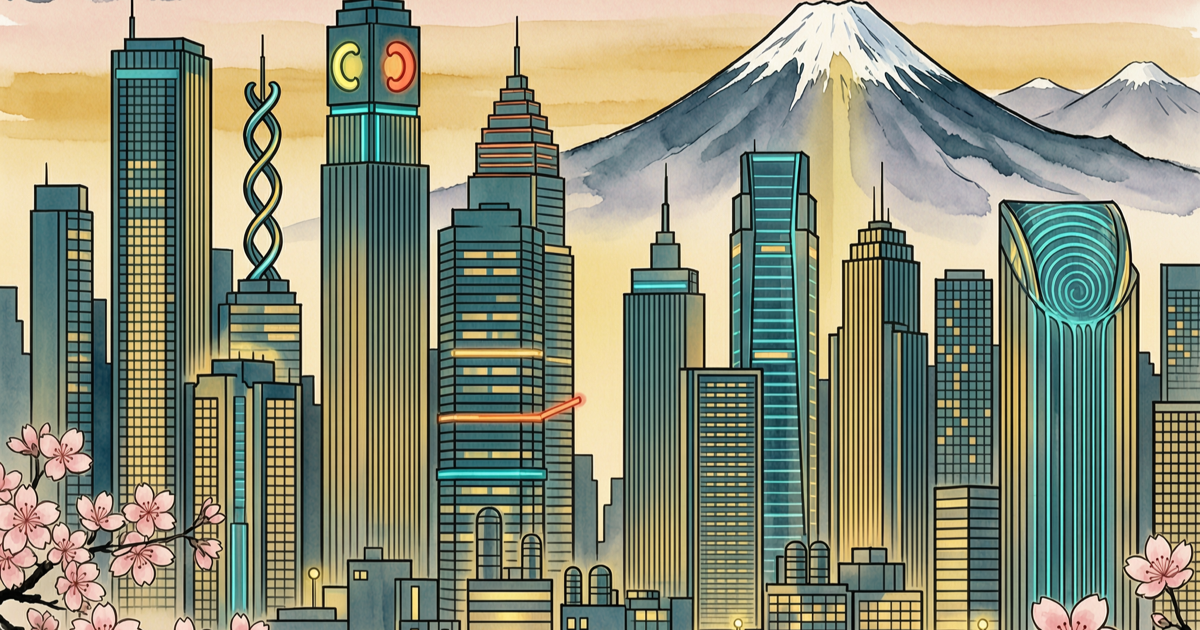
Want to understand what element Tokyo truly belongs to? Many people first think of the red sun on Japan's flag, the neon lights of Shibuya, and the glow of anime, and blurt out: the Land of the Rising Sun, so it must be Fire, right?
The red sun and neon are indeed Tokyo's most dazzling surface. But if you've actually lived in Tokyo—seen the spotless, punctual subway system, experienced the sushi master's lifelong dedication to a single craft, felt the city's restrained, precise, almost obsessive orderliness—you'll understand that Tokyo's true soul is not blazing Fire, but calm, precise, and disciplined Metal.
In this article, we'll use the same BaZi method for analyzing cities and patterns to break down Tokyo's Five Elements layer by layer.
Conclusion First
Tokyo's Five Elements form a city where "Metal casts the soul, Wood and Fire form the surface."
- Surface is Wood and Fire: Japan is called the "Land of the Rising Sun," and that red sun represents Fire. Japan is also located east of the Asian continent, and the East belongs to Wood. Combined with its deep reverence for nature, cherry blossoms, and the four seasons—this layer of Wood and Fire is Tokyo's first impression on the world.
- True soul is Metal: What makes Tokyo Tokyo is its extreme precision, order, restraint, and craftsmanship. Metal governs rules, discipline, precision, and nobility—the punctual trains, meticulous service, and the craftsman's lifelong devotion are all expressions of Metal.
- Metal and Fire complement each other: Wood and Fire give Tokyo its form (the heat of sunrise, the glow of neon and anime), while Metal gives it its soul (calm precision and order). Fire tempers Metal, and Metal refines Fire—in BaZi, this is the "Metal and Fire Complement Each Other" pattern: Fire's energy is channeled by Metal's discipline, forging a unique temperament of "extreme calm beneath a lively surface."
In one sentence: Tokyo is a city where "Wood and Fire give birth to its form, Metal casts its soul." On the surface, it's the Wood and Fire of the rising sun in the East, but its core is a piece of Metal, repeatedly polished to a calm, gleaming finish.
Try your own BaZi reading
Get an AI-powered personalized BaZi analysis from your birth info.
Start free analysisDirectional Elements: Why Does Tokyo's Elemental Foundation Carry 'Wood and Fire'?
In traditional BaZi, elements are not only seen in a person's chart but also in spatial directions. The classic correspondences are:
- East belongs to Wood (spring, growth)
- South belongs to Fire (summer, heat)
- West belongs to Metal (autumn, contraction)
- North belongs to Water (winter, cold)
- Center belongs to Earth
Japan lies off the eastern coast of the Asian continent. Relative to the entire East Asian cultural sphere, it is located eastward—the East belongs to Wood, governing growth, expansion, and upward movement. Coupled with Japan's reverence for nature (Shintoism, cherry blossom mono no aware, seasonal sensitivity), this affinity for plants and breathing with the seasons is the essence of Wood.
And the term "Land of the Rising Sun" directly points to Fire. The sun rises in the east, and Japan is the first place to greet the sunrise. The red sun on its flag is the most vivid symbol of Fire. So Tokyo's innate foundation indeed lies between Wood and Fire—Wood from the east, Fire from the sunrise. But this is only its "surface" layer, not its soul.
Sunrise and Neon: The Wood and Fire Hidden in Tokyo's Surface
Tokyo's Wood and Fire are not only in its direction and flag but are also alive in the city's expression.
First, Fire. Tokyo's night is one of the brightest in the world:
- The dense neon signs and advertising screens in Shibuya and Shinjuku are the ultimate expression of Fire's "light";
- Anime, games, pop culture—these glowing, passion-igniting energies that radiate to the world are all within Fire's domain.
Next, Wood. Beneath the concrete jungle, Tokyo always harbors a gentle Wood energy: the cherry blossoms of Ueno, the forest of Meiji Jingu, the delicate appreciation of plants through the changing seasons. The Japanese concepts of "mono no aware" and "wabi-sabi" are essentially a deep affection for the birth and death of nature (Wood).
Wood and Fire intertwine here, forming Tokyo's glamorous, lively, and vibrant "surface." But note—this is only the form, not the soul. What truly makes this city run so precisely is the Metal hidden beneath the Wood and Fire.
The True Soul: Why Is Tokyo a 'Metal' City?
Lift the veil of neon and cherry blossoms, and you'll see Tokyo's true bones—Metal.
In the Five Elements, Metal governs rules, order, discipline, precision, and nobility. Anything that emphasizes discipline, precision, craftsmanship, and adherence to rules belongs to Metal. And Tokyo has elevated Metal to a world-class extreme:
- Punctual order: Tokyo's trains are famous for being "late by seconds." The entire city operates like a precisely meshed machine—this is the embodiment of Metal's "order and precision.";
- Lifelong craftsmanship: The sushi master, the culture of artisans—dedicating a lifetime to perfecting a single craft—this devotion to craft is Metal's nobility;
- Restraint and rules: The collective character of not causing trouble for others (迷惑をかけない) and adhering to etiquette and order is the foundation of Metal's "discipline and uprightness."
The neon Fire is lively, but what prevents Fire from running wild and keeps the city running calmly is this Metal. Tokyo's soul is Metal.
Try your own BaZi reading
Get an AI-powered personalized BaZi analysis from your birth info.
Start free analysisMetal and Fire Complement Each Other: Wood and Fire Give Form, Metal Casts the Soul
Combining the surface Wood and Fire with the core Metal completes Tokyo's pattern—it is a beautiful "Metal and Fire Complement Each Other."
In BaZi, there is a pattern called "Metal and Fire Complement Each Other": Metal is hard, and Fire can temper it; Fire is strong, and Metal can contain it. Without Fire, Metal is just stubborn iron; without Metal, Fire is just wild flames. When Fire and Metal complete each other, Metal becomes pure and sharp, and Fire becomes steady and bright.
This is exactly Tokyo's portrait:
- Wood and Fire give form—the Fire of sunrise, the light of neon and anime, the vitality of eastern Wood, giving Tokyo a lively, glamorous, and energetic exterior;
- Metal casts the soul—extreme precision, order, and artisan discipline channel, polish, and refine this energy into a unique texture of "extreme calm beneath the bustle, extreme restraint behind the glamour."
A city can simultaneously possess the heat of neon and the precision of trains, the exuberance of anime and the restraint of artisans, precisely because of this "Metal and Fire complement each other"—Fire gives it light and heat, Metal gives it form and soul. Understanding this layer of Metal is understanding why Tokyo is Tokyo.
How to Determine a City's Five Elements: A Method for Everyone
After reading about Tokyo, you've already grasped a method applicable anywhere. To determine a city's elemental tendency, cross-reference from four angles:
- Direction and climate: East (growth) leans Wood, South (heat) leans Fire, West (discipline) leans Metal, North (cold) leans Water, Center leans Earth. This is the "environmental element."
- Surface vs. core: Don't just look at first impressions. Tokyo's surface is Wood and Fire (neon, cherry blossoms), but its soul is Metal (precision, order)—the surface element and the dominant element are often two layers.
- Industry and character: Precision craftsmanship/institutions → Metal, culture/light/electronics → Fire, natural growth → Wood, trade/ports → Water, political power → Earth.
- Collective character: Is the city "precision-oriented" (Metal), "expansive" (Fire), "growth-oriented" (Wood), "fluid" (Water), or "stable" (Earth)?
Stack these layers, and you won't get a simplistic answer like "the Land of the Rising Sun is Fire," but a three-dimensional pattern. The same logic applies perfectly to your own BaZi—your birth season is one layer, while your element strengths and favorable gods are the structural layer. The latter determines what you truly thrive on, what you lack, and which direction suits you.
Try your own BaZi reading
Get an AI-powered personalized BaZi analysis from your birth info.
Start free analysisFrequently Asked Questions
Q1: Does Tokyo belong to Fire or Metal? Two layers. Surface belongs to Wood and Fire (Fire of the rising sun, Wood of eastern plants, light of neon and anime), true soul belongs to Metal (extreme precision, order, artisan restraint). In one sentence: Tokyo is a city where "Wood and Fire give form, Metal casts the soul," with the core in Metal.
Q2: Japan is the 'Land of the Rising Sun,' so why isn't Tokyo's dominant element Fire? "Land of the Rising Sun" refers to Japan's direction and symbolism (east, greeting the sun)—this is its environmental foundation. But what determines a city's dominant element is its character and mode of operation. Tokyo's most prominent character is precision, order, and restraint, which corresponds to Metal in the Five Elements, not Fire. Fire is its light, but Metal is its bone.
Q3: What use is knowing a city's Five Elements to me? The most practical use is matching: If your BaZi favors Metal (needs order, discipline, precision, rules), a Metal-heavy city like Tokyo may be especially suitable for your development. If you favor Wood, Fire, Water, or Earth, that's another choice. First, understand your own elemental preferences, then match them to the environment—much smarter than blindly following trends.
Conclusion
The question "What element does Tokyo belong to?" is easily swayed by the red sun and city neon. But once you experience the punctual order and lifelong devotion, you'll understand—Tokyo's soul is Metal, not Fire.
The Fire of sunrise and the Wood of the east give it a glamorous, lively form. But the extreme precision, restraint, and orderly Metal are the soul that keeps everything running calmly and polished to a shine. Metal and Fire complement each other; Wood and Fire give form—this is the Five Elements code of a city that is both exuberant and calm.
And the same principle lies within your own BaZi. Are you a Metal-strong, order-oriented pattern, or a completely different combination? First, see your own elements clearly, then you'll know which land and which path best allow you to shine.