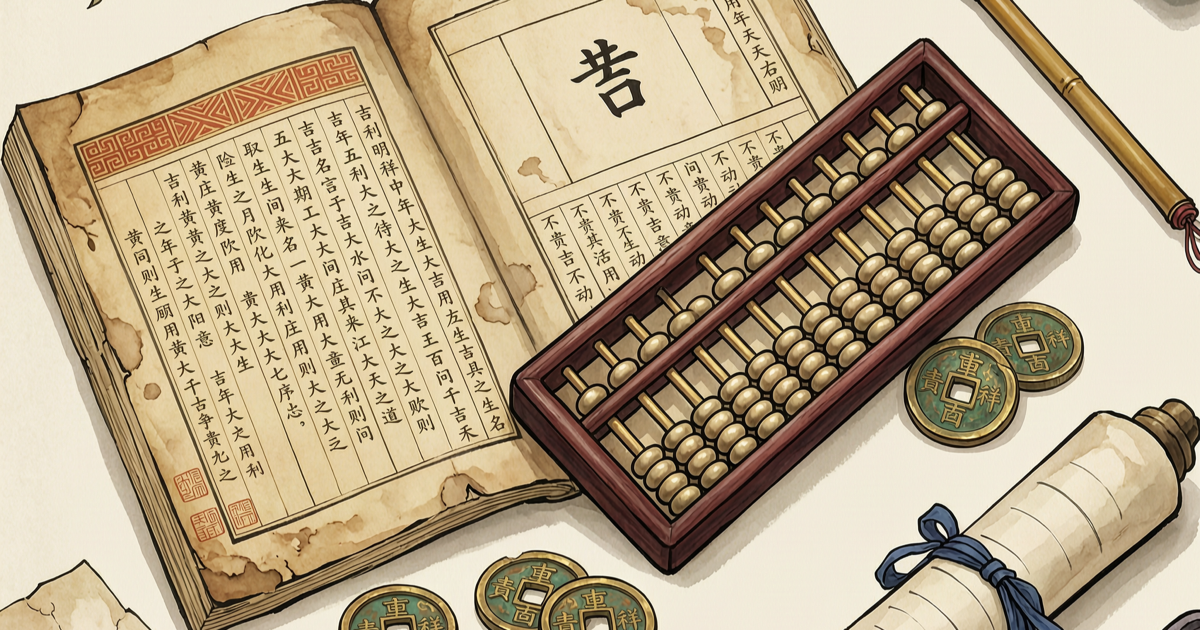
Before signing a major contract, opening a new shop, or entering a partnership, ancient people almost always 'chose an auspicious day'—they would consult the almanac and pick a day marked as favorable for 'Transaction,' 'Receive Wealth,' or 'Opening Market.' This wasn't superstitious lottery-winning thinking; it was a practical decision-making wisdom: arranging an important, somewhat uncertain matter at a time when your mindset is most stable and external distractions are minimal.
Applied today, this logic is far from outdated. Whether you're signing an investment contract, finalizing a large transfer, negotiating a business deal, or simply wanting to pick a day for an important financial decision—the 'day-selection' framework left by the ancients can still give you a reference to calm down and set the right pace.
Check today's almanac
Look up today's pillars, do's & don'ts, and clashes — plus your personal lucky timing from your chart.
Open the almanacLet's be clear upfront: Day-selection does not guarantee you'll make money, nor is it a tool for speculation. What it can help with is 'rhythm' and 'mindset,' not 'outcome.' Let's break this down below.
Why Did Ancient People 'Choose an Auspicious Day' Before Major Business Deals?
In an agricultural society, a land purchase, an IOU, or the opening of a shop often represented a family's savings for years or even half a lifetime. There were no bank reconciliations, no contract laws, no room for regret—once the deal was struck, it was hard to reverse.
In such a high-risk, low-error-tolerance environment, 'choosing an auspicious day' was actually a ritualized form of risk management:
- Forcing yourself to slow down. Waiting for a good day meant you wouldn't sign impulsively in the heat of the moment or under flattery. The waiting itself filtered out most impulsive decisions.
- Aligning everyone's mindset. If both parties recognized the day as 'auspicious,' the negotiation atmosphere, sincerity, and mutual seriousness would all be different. When something is treated as important, the chance of error naturally decreases.
- Providing a definite anchor for the decision. Turning a vague 'let's find a time soon' into a concrete 'this day' moves things forward and ensures someone is truly accountable.
See? None of these three points have anything to do with 'superstition'—they are all solid decision psychology.
What Exactly Do 'Transaction, Receive Wealth, Opening Market' Mean in the Almanac?
Many people only look at the almanac for 'favorable for marriage' or 'favorable for travel.' In fact, the traditional almanac has a specific set of items related to 'money':
| Almanac Item | Corresponding Modern Scenario |
|---|---|
| Transaction (交易) | Signing contracts, closing deals, buying/selling, transfer of ownership, picking up a car |
| Receive Wealth (納財) | Receiving income, collecting payments, collecting rent, investing in shares, purchasing property |
| Establish Contract (立券) | Drafting contracts, loans, signing agreements |
| Opening Market (開市) | Business opening, launch, official start of a new venture |
When a day's almanac 'favorable' column includes 'Transaction' or 'Receive Wealth,' tradition holds that the overall energy of that day is suitable for 'money transactions and finalizing deals'; if it falls under 'unfavorable,' it warns against rash actions on that day.
The key point is: This is calculated based on the day's actual Stem-Branch (干支), Day Deity (值神), and Clashes (沖煞)—not just random auspicious phrases. In a given month, there may only be a few days favorable for transactions—this is what the ancients were really 'selecting.'
How Can Modern People 'Apply Ancient Wisdom to Modern Use'?
To apply ancient wisdom today, the key is not to accept it wholesale but to extract its reasonable core. Specifically for financial decisions, you can use it like this:
1. For major, irreversible decisions, it's worth picking a day. Buying a house, signing a long-term contract, entering a partnership—these are things that are hard to reverse once signed. Choosing a day favorable for 'Transaction' and 'Receive Wealth' that doesn't clash with your zodiac sign is essentially a reminder to 'take it seriously and don't rush to decide.'
2. Avoid days with obvious clashes or negative influences. Every day in the almanac has 'clashes with certain zodiac signs' and 'negative directions.' If a day clashes with your zodiac sign, tradition suggests not handling major affairs on that day—not because something bad will definitely happen, but because 'your mind may be easily disturbed that day, so it's better to reschedule.' For a financial decision requiring calm judgment, this reminder is valuable.
3. Treat 'auspicious days' as a starting gun for action, not a guarantee of profit. The day helps you set the rhythm and stabilize your mindset, but what truly determines profit or loss is always the quality of the decision itself—how much homework you've done, how well you've assessed the risks. An auspicious day helps you 'make decisions in a better state,' not 'make decisions for you.'
Can You Rely on the Almanac for 'Lottery, Stock Trading'?
Some may ask: If I buy lottery tickets, trade stocks, or invest in funds, will picking a day favorable for 'Receive Wealth' increase my chances of winning?
Honestly: For purely speculative matters, the almanac provides very limited reference and should never be treated as a wealth-building strategy. Lotteries are inherently random; no day-selection can change the odds of winning. Stock market gains and losses depend on your research, discipline, and risk control, not on which day has 'good energy.'
If you really want to use it, at most borrow the act of 'choosing a day' to install a rational valve for yourself—while picking the day, calmly ask yourself: 'Can I afford to lose this money?' That is often more important than whether you win or not.
⚠️ Rational Reminder: Investing involves risk. The almanac is a cultural reference, not investment advice. Any claim that 'picking a good day guarantees profit' is unreliable. Act within your means; don't gamble with money needed for living expenses.
Want to Pick a Day for Your Financial Decisions?
Shunshi Almanac is based on real Stem-Branch (干支) calculations: when you ask 'Is today suitable for investing?' or 'Which days this month are favorable for transactions?', it checks whether that day's almanac includes 'Transaction' or 'Receive Wealth,' then combines it with the day's Day Deity (值神), Clashes (沖煞), and Wealth God direction (財神方位) to give you a well-founded judgment—not a vague auspicious phrase.
Check today's almanac
Look up today's pillars, do's & don'ts, and clashes — plus your personal lucky timing from your chart.
Open the almanacWhen the ancients chose a day, they were never just picking a date; they were embracing a mindset of 'treating important decisions with seriousness.' May you, when making every decision related to money, first stabilize yourself—this is the most valuable part of 'applying ancient wisdom to modern use.'