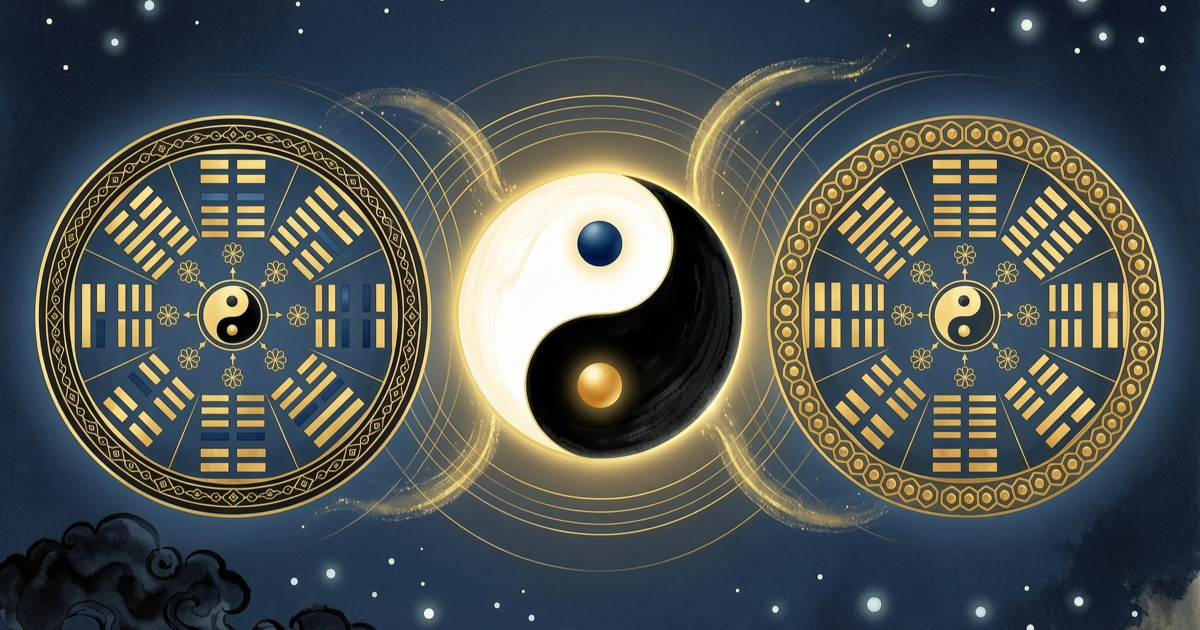
You have probably seen two Bagua diagrams that look similar but don't align: one has Qian at the top and Kun at the bottom, symmetrical like a mirror; the other places Li at the top and Kan at the bottom. They are called Pre-Heaven Bagua and Post-Heaven Bagua—only two characters apart in name, but they represent two completely different worldviews. This article will clearly explain both diagrams—what the difference is, who arranged them, what each governs, and which one to use in Feng Shui, Six Lines, and Fortune Analysis.
Conclusion First
Pre-Heaven Bagua, traditionally attributed to Fuxi, emphasizes 'opposition'—Heaven and Earth, Water and Fire, Thunder and Wind, Mountain and Lake are paired in opposition, describing the substance and structure of the universe before movement, hence 'Pre-Heaven as Substance'. Post-Heaven Bagua, traditionally attributed to King Wen of Zhou, emphasizes 'circulation'—the eight trigrams rotate through spring, summer, autumn, winter, and the four cardinal directions, describing the operation and application of all things after movement, hence 'Post-Heaven as Function'.
One sentence to distinguish: Pre-Heaven discusses substance, Post-Heaven discusses function. Use Pre-Heaven to understand how Heaven and Earth generate all things and the symmetrical relationship of Yin and Yang; use Post-Heaven for calculating directions, seasons, Feng Shui arrangements, and casting Six Lines divination. This is why the Bagua you see on compasses, Yang dwellings, and Xuan Kong Flying Stars is always Post-Heaven—because those are all fields of 'function'.
Try your own BaZi reading
Get an AI-powered personalized BaZi analysis from your birth info.
Start free analysisWho Arranged the Pre-Heaven Bagua? What Does 'Opposition' Mean?
The Pre-Heaven Bagua, also called 'Fuxi Bagua', is said to have been created by Fuxi after observing the heavens and earth, taking patterns from his own body and external objects. Its core keyword is two characters: opposition.
Opposition means that the eight trigrams form pairs that are opposite and complementary, like mirror images. The specific correspondences are:
- Qian (Heaven) opposes Kun (Earth)—pure Yang above, pure Yin below
- Kan (Water) opposes Li (Fire)—Water and Fire are incompatible yet interdependent
- Zhen (Thunder) opposes Xun (Wind)—one moves, one enters
- Gen (Mountain) opposes Dui (Lake)—one stops, one delights
These four pairs of opposition are the visual representation of the passage in the Shuo Gua Zhuan of the Yijing: 'Heaven and Earth establish positions, Mountain and Lake interpenetrate, Thunder and Wind clash, Water and Fire do not harm each other'. Pre-Heaven Bagua does not discuss temporal sequence but rather the fundamental order of spatial structure and the waxing and waning of Yin and Yang—it describes the original state of all things 'before they began to operate'.
Arranging the Pre-Heaven trigram sequence according to the waxing and waning of Yin and Yang, from Qian 1, Dui 2, Li 3, Zhen 4, to Xun 5, Kan 6, Gen 7, Kun 8, you see a complete cycle of Yang energy from fullness to decline and Yin energy from birth to fullness. This is why Shao Yong of the Song Dynasty valued the Pre-Heaven diagram so much: it is a mathematical model of generative principles, directly linked to the rhythm of Yin-Yang waxing and waning.
Who Arranged the Post-Heaven Bagua? What Is 'Circulation'?
The Post-Heaven Bagua, also called 'King Wen Bagua', is said to have been developed by King Wen while imprisoned at Youli. Its core keyword is also two characters: circulation.
Circulation means 'rotation, cycle, and effect'. Post-Heaven Bagua no longer emphasizes symmetry but places the eight trigrams in eight directions, arranged according to the seasonal cycle of the year and the daily cycle of day and night:
- Zhen in the East—corresponds to spring, the birth of Wood energy
- Li in the South—corresponds to summer, the peak of Fire energy
- Dui in the West—corresponds to autumn, the convergence of Metal energy
- Kan in the North—corresponds to winter, the hiding of Water energy
- The four corners are assigned Xun (Southeast), Kun (Southwest), Qian (Northwest), and Gen (Northeast)
You will find that the directional arrangement of Post-Heaven Bagua perfectly matches the familiar Five Elements generation and control cycles and the flow of the four seasons: East Wood, South Fire, West Metal, North Water, with Earth in the center. This is the key to why Post-Heaven Bagua can be used for 'function'—it connects abstract trigram symbols to real-world time and space coordinates.
The passage in the Shuo Gua Zhuan: 'The Emperor emerges in Zhen, is aligned in Xun, appears in Li, labors in Kun, speaks in Dui, fights in Qian, toils in Kan, and completes in Gen' describes how Post-Heaven Bagua takes turns governing according to the solar terms. Simply put, Pre-Heaven says 'what it is', Post-Heaven says 'how it moves'.
Complete Orientation Comparison: The Same Trigram, Completely Different Positions
The most confusing aspect is that the same trigram has entirely different positions in the two diagrams. Below is a side-by-side comparison for quick understanding:
| Trigram | Pre-Heaven Orientation | Post-Heaven Orientation |
|---|---|---|
| Qian (Heaven) | Due South | Northwest |
| Kun (Earth) | Due North | Southwest |
| Li (Fire) | Due East | Due South |
| Kan (Water) | Due West | Due North |
| Zhen (Thunder) | Northeast | Due East |
| Xun (Wind) | Southwest | Southeast |
| Gen (Mountain) | Northwest | Northeast |
| Dui (Lake) | Southeast | Due West |
From this table, several key points emerge:
- In Pre-Heaven, Qian and Kun are at top and bottom (north-south); in Post-Heaven, they move to the northwest and southwest corners—because Pre-Heaven discusses the fundamental positioning of Heaven's nobility and Earth's humility, while Post-Heaven discusses the circulation of energy, with pure Yang and pure Yin retreating to auxiliary positions.
- In Post-Heaven, Kan and Li occupy the north-south axis—Li Fire in the south, Kan Water in the north, perfectly matching the common knowledge that 'south belongs to Fire, north belongs to Water', evidence that Post-Heaven is closer to reality.
- The easiest way to distinguish the two diagrams: check whether the south position holds Qian (Heaven) or Li (Fire). South Qian is Pre-Heaven, South Li is Post-Heaven.
Because the directional arrangements differ, the application scenarios of the two systems are completely separate.
Pre-Heaven as Substance, Post-Heaven as Function: Which System Is Used in Feng Shui, Six Lines, and Fortune Analysis?
Understanding 'substance' and 'function' allows us to answer the most practical question—when to use which system?
Feng Shui (Yang dwellings, compass, Xuan Kong): Almost entirely Post-Heaven. The 24 mountains on the compass, the East Four and West Four houses of the Eight Mansions school, and the Yuan Yun charts of Xuan Kong Flying Stars all use Post-Heaven orientations as the standard. The reason is simple: Feng Shui deals with the flow of energy in real space, which falls under the category of 'function', so it naturally uses the Post-Heaven diagram that emphasizes circulation. Pre-Heaven Bagua is mostly used only as a theoretical foundation or as a reference for certain specific methods (such as Pre-Heaven Water Method).
Six Lines (Najia divination): Casting and setting up the hexagram use Post-Heaven. Six Lines assigns Heavenly Stems and Earthly Branches and Earthly Branch directions to the trigrams to judge auspiciousness and timing, operating within the Post-Heaven space-time coordinate system. The Pre-Heaven trigram sequence is used in the generation of hexagrams and certain theoretical derivations.
Plum Blossom Numerology: Both substance and function are important, but judgment emphasizes Post-Heaven. Plum Blossom Numerology uses Pre-Heaven numbers (Qian 1, Dui 2, Li 3, Zhen 4…) when casting hexagrams—this is its basis for obtaining numbers; but when it comes to judging auspiciousness based on direction and Five Element generation and control, it returns to the Post-Heaven framework. Thus, Plum Blossom Numerology best embodies the substance-function coordination of 'Pre-Heaven for numbers, Post-Heaven for judgment'.
BaZi Fortune Analysis: Does not directly use Bagua, but shares the Post-Heaven Five Element space-time view. Strictly speaking, BaZi charting uses Heavenly Stems, Earthly Branches, and Five Element generation and control, without directly placing Bagua diagrams; however, the space-time correspondences in BaZi—'south Fire, north Water, spring Wood, summer Fire'—share the same root as Post-Heaven Bagua, both being the thinking of 'circulation as function'. So understanding Post-Heaven Bagua will greatly enhance your comprehension of Five Element strength and seasonal adjustment in BaZi. To experience this Post-Heaven Five Element space-time view firsthand, you can use the free BaZi charting tool to generate your own birth chart and see where the Five Elements fall in terms of direction.
One sentence summary of each system's use: Pre-Heaven is the principle of the map, Post-Heaven is the route of navigation. Study Yili and the generation of Heaven and Earth with Pre-Heaven; apply to direction, season, and auspicious judgment with Post-Heaven.
Why Are There Two Systems? Are They Contradictory or Complementary?
Many people, upon first seeing the two diagrams, ask: since the orientations differ, aren't they contradictory?
In fact, they are not contradictory at all; rather, they represent two levels of a complete system. The classic saying in traditional Yixue is: 'Pre-Heaven as substance, Post-Heaven as function; substance and function share one source, the manifest and the subtle are without gap'.
To use an analogy: Pre-Heaven Bagua is like the blueprint of a building—it tells you how the structure bears force and how Yin and Yang balance; it is static and fundamental. Post-Heaven Bagua is like the circulation diagram of the building in actual operation—how people enter and exit, how energy flows, how the seasons affect lighting; it is dynamic and applied.
The blueprint is not used to direct people's movement, and the circulation diagram cannot exist without the structural support of the blueprint. Pre-Heaven establishes the fundamental order of Yin-Yang opposition, and Post-Heaven unfolds the actual operation of space-time circulation based on this order. The two are two sides of the same coin, indispensable.
Therefore, serious Yixue researchers never 'only learn Post-Heaven without understanding Pre-Heaven'—because without understanding the principle of opposition in Pre-Heaven, the circulation of Post-Heaven becomes rootless; but practical operations (Feng Shui, divination) cannot do without Post-Heaven, as it is the system that connects to reality.
Inspiration for Ordinary People: Understanding Life Through the Substance-Function of Bagua
Extracting the wisdom of Pre-Heaven and Post-Heaven from divination techniques can also inspire ordinary people.
Pre-Heaven is your 'hand', Post-Heaven is your 'play'. A person's talent, personality, and destiny structure are like Pre-Heaven—relatively fixed 'substance'; but how you express yourself in different seasons, environments, and ways is like Post-Heaven—adjustable 'function'. Recognizing your own 'substance' allows you to find the smoothest 'function'—this is the attitude of going with the flow: not to defy fate, but to follow your inherent structure and exert effort in the right time and space.
This is why understanding your own BaZi birth chart is so important: BaZi is the concrete manifestation of your 'Pre-Heaven blueprint'. Once you see the distribution of Five Elements and Yin-Yang, you know which direction is favorable and which needs supplementation.
Frequently Asked Questions
Q: Which is more accurate or superior, Pre-Heaven or Post-Heaven Bagua? There is no hierarchy, only differences in application. Pre-Heaven discusses principles (substance), Post-Heaven discusses application (function); they are two levels of the same system. Practical divination and Feng Shui mostly use Post-Heaven, while theoretical research often discusses Pre-Heaven; they complement each other.
Q: Which Bagua system is used on a Feng Shui compass? Primarily Post-Heaven Bagua (King Wen Bagua). The 24 mountains, Eight Mansions, and Xuan Kong Flying Stars on the compass all use Post-Heaven orientations as the standard, because Feng Shui deals with the circulation of energy in real space.
Q: How can I quickly distinguish the two Bagua diagrams? Look at the due south position: if it contains 'Qian (Heaven)', it is Pre-Heaven Bagua; if it contains 'Li (Fire)', it is Post-Heaven Bagua. This is the fastest way to tell.
Q: Does BaZi fortune analysis use Bagua? BaZi charting itself uses Heavenly Stems, Earthly Branches, and the Five Elements, without directly placing Bagua diagrams; however, the Five Element space-time correspondences in BaZi (south Fire, north Water, spring Wood, summer Fire) share the same origin as Post-Heaven Bagua, so understanding Post-Heaven helps in reading BaZi's strength and seasonal adjustments.
Conclusion
The difference between Pre-Heaven and Post-Heaven Bagua has never been about which diagram is more correct; rather, they answer different questions at different levels: one discusses the structural substance of the universe (opposition, as substance), the other discusses the actual operation of all things (circulation, as function). Remember the six characters 'Pre-Heaven discusses substance, Post-Heaven discusses function', and you will gain a deeper understanding when looking at compasses, Six Lines, Plum Blossom Numerology, and even your own birth chart.
Having understood the substance-function relationship of Bagua, you might also look back at your own 'Pre-Heaven blueprint'—your BaZi birth chart is precisely that diagram of opposition belonging to you.