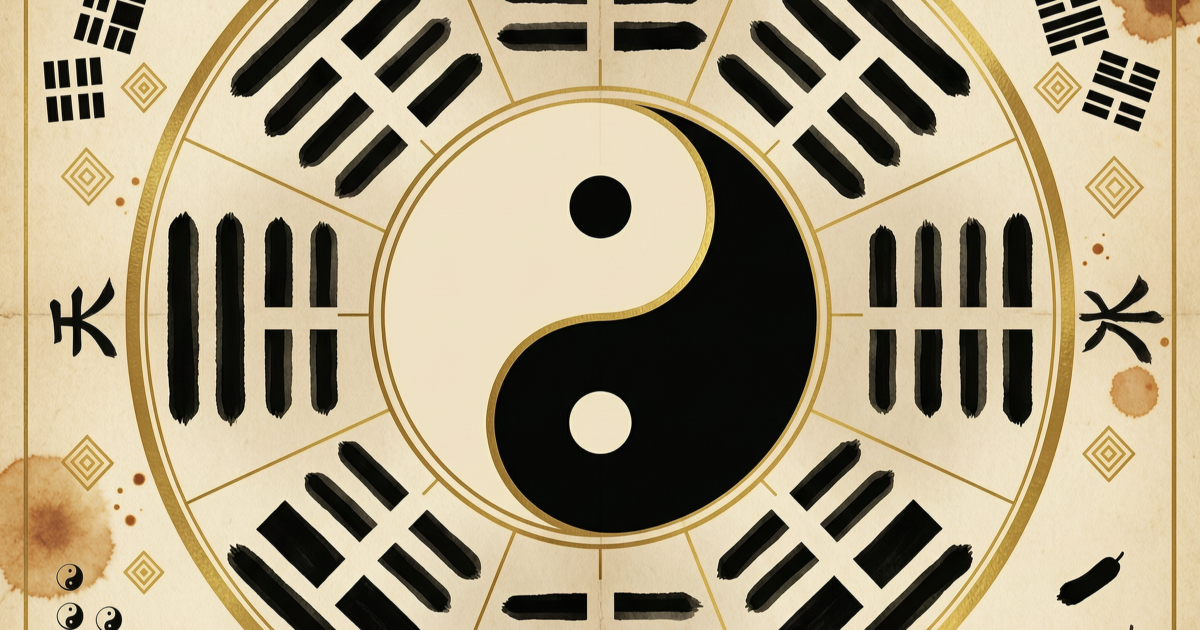
Many people's first impression of the 'I Ching' is an ancient, unreadable book, or the fortune sticks and divination blocks used by temple elders. In reality, the I Ching is the source of all Chinese metaphysical arts; even BaZi and Zi Wei Dou Shu grew out of its Yin-Yang and Five Elements. Its most fascinating application is divination – when faced with a decision, you cast a hexagram, and the hexagram gives you an 'answer for this moment.'
The logic of I Ching divination is actually very simple: The world is composed of two energies, 'Yin' and 'Yang.' Stacking Yin and Yang three times creates the 'Eight Trigrams,' and stacking two trigrams on top of each other creates the '64 Hexagrams.' Each hexagram corresponds to a life situation. You ask a question and cast a hexagram, using an ancient coordinate system to locate your current situation – it doesn't calculate your 'fate,' but answers: 'What is the state of this matter at this moment? Should I advance or retreat?'
Try your own BaZi reading
Get an AI-powered personalized BaZi analysis from your birth info.
Start free analysis1. What Exactly is the I Ching? Not Just a Fortune-Telling Book
Let's first clear up a misconception: The I Ching is not a 'fortune-telling book'; it is a model for explaining how the world works.
The character 'Yi' itself has three meanings: Change (everything changes), Simplicity (complex changes can be expressed with simple symbols), and Constancy (there are unchanging laws behind change). Ancient people observed heaven, earth, the four seasons, day and night, and found that everything oscillates between 'Yin' and 'Yang' – day and night, cold and heat, advance and retreat. So they used the most concise symbols to record this law.
This symbolic system later split into two paths:
- One path led to philosophy: The hexagram statements, line statements, and the Ten Wings of the I Ching discuss wisdom for life (e.g., 'As heaven moves with vigor, a gentleman strives to constantly strengthen himself' comes from here).
- One path led to divination: Using methods to cast hexagrams, applying abstract hexagram symbols to specific questions, giving directional answers.
This article focuses on the latter – how to get started with divination. But to divine, you must first understand how hexagrams are constructed.
2. The Starting Point: Yin and Yang
The entire I Ching is built on two basic symbols:
- Yang line: A solid horizontal line
⚊, representing firmness, movement, advance, brightness. - Yin line: A broken horizontal line
⚋, representing softness, stillness, retreat, darkness.
That's it. All hexagrams are 'stacked' from these two lines. This is why some say the I Ching is the 'earliest binary system' – it truly uses only two symbols to describe the entire world.
Yin and Yang are not 'good' and 'bad'; they are a pair of interdependent forces that transform into each other. Extreme Yang gives rise to Yin (peak leads to decline), and extreme Yin gives rise to Yang (extreme adversity leads to good fortune). This concept of 'transformation' is the soul of divination: even the worst hexagram contains a chance for reversal; even the best hexagram warns you not to go too far.
3. From Two Modes to Eight Trigrams: Three Lines Yield Eight Situations
Stacking the two symbols, Yin and Yang, three layers yields how many combinations? 2 × 2 × 2 = 8. These eight are the famous 'Eight Trigrams.'
Each trigram has three lines (called 'yao'), read from bottom to top. Each trigram corresponds to a natural image and an energy state:
| Trigram | Symbol Image | Nature | Quality |
|---|---|---|---|
| Qian | ☰ Three Yang | Heaven | Strong, leading |
| Kun | ☷ Three Yin | Earth | Yielding, supporting |
| Zhen | ☳ | Thunder | Shocking, arousing |
| Xun | ☴ | Wind | Penetrating, compliant |
| Kan | ☵ | Water | Dangerous, flowing |
| Li | ☲ | Fire | Bright, clinging |
| Gen | ☶ | Mountain | Stillness, stability |
| Dui | ☱ | Lake | Joy, communication |
No need to memorize by rote. Remember a trick: All Yang is Heaven (Qian), all Yin is Earth (Kun); the other six trigrams are 'intermediate states' between heaven and earth with varying amounts of Yin and Yang. Qian and Kun are the parents; the other six are their children – a microcosm of the I Ching's 'Heaven and Earth give birth to all things.'
Each trigram also corresponds to one of the Five Elements: Qian and Dui belong to Metal; Zhen and Xun belong to Wood; Kan belongs to Water; Li belongs to Fire; Gen and Kun belong to Earth. This is the same Five Elements foundation shared by the I Ching and BaZi – you'll find they are essentially two forms of the same system.
4. How Do Eight Trigrams Become 64 Hexagrams? Stack One on Top of Another
Eight trigrams are too coarse to describe complex life situations. So the ancients took another step: stack two trigrams on top of each other – a lower three-line trigram (lower trigram) and an upper three-line trigram (upper trigram), forming a six-line 'compound hexagram.'
8 × 8 = 64. This is the origin of the '64 Hexagrams.'
Each 64-hexagram is a combination of 'lower trigram + upper trigram,' and the reading method is to see what happens when these two images meet. Here are two easiest-to-understand examples:
- Tai Hexagram: Lower trigram is Qian (Heaven), upper trigram is Kun (Earth). Heaven's energy rises, Earth's energy descends; the two energies meet → 'Prosperity,' symbolizing smoothness and harmony. Hence 'Three Yangs bring Peace' is very auspicious.
- Pi Hexagram: The reverse: lower Kun (Earth), upper Qian (Heaven). Heaven goes up, Earth sinks down; the two go their separate ways without interaction → 'Stagnation,' symbolizing blockage and obstruction.
See? With the same Heaven and Earth, swapping positions reverses the auspiciousness. This is the essence of I Ching divination: the answer lies not in a single symbol, but in relationships and positions. The 64 hexagrams are 64 'scripts of relationships.'
5. How to Cast a Hexagram for a Question? Two Most Common Methods
Now that you understand how hexagrams are formed, it's time for practice: When faced with a matter, how do you 'cast' a hexagram?
Two most common methods for beginners:
1. Coin Method Take three coins, silently focus on your question, shake them, and toss them on a table. Determine one line (Yin or Yang) based on heads and tails. Repeat six times, stacking the lines from bottom to top to form a six-line hexagram. This is the most popular folk method; simple tools – a few coins are enough to cast a hexagram.
2. Time-Based Casting (Plum Blossom Numerology) Use the numbers of the 'year, month, day, hour' at the moment of asking, and convert them into the upper trigram, lower trigram, and moving line through fixed formulas. It requires no props, relying solely on the information of 'this very moment' – this method is called Plum Blossom Numerology, attributed to Shao Yong of the Song Dynasty.
Regardless of the method, the core concept is the same: Casting a hexagram translates the state of 'this moment' into a hexagram symbol. You are not 'deciding' the answer; you are 'reading' the signal given by heaven and earth at this moment. This is also the biggest difference between divination and superstition – it is essentially a thinking tool that uses an ancient coordinate system to locate the current situation.
6. After Casting a Hexagram, How to Read It?
After casting a hexagram, you get two key pieces of information:
- Primary Hexagram: The hexagram formed by the six lines, representing the 'current state' of the matter. Look up its name and hexagram statement (e.g., getting the Tai hexagram leans toward smoothness; the Pi hexagram leans toward stagnation).
- Moving Line: During casting, one line is marked as 'changing'; it represents the key turning point of the matter, the aspect most worth attention. When the moving line changes, the primary hexagram transforms into another 'derived hexagram,' representing 'where the matter is heading.'
Thus, a complete divination reads the dynamic line 'from the primary hexagram to the derived hexagram' – how things are now, where the blockage is, and what they will become. Compared to a rigid 'auspicious' or 'inauspicious,' it gives a directional, process-oriented judgment.
Beginners don't need to memorize the statements of all 64 hexagrams from the start. First grasp the framework of 'trigram imagery + relationship between upper and lower trigrams.' If you can look at a hexagram and say, 'Heaven above Earth means stagnation; Heaven below Earth means prosperity,' you've already entered the door. The remaining hexagram statements can be looked up; the truly difficult part is the mindset that 'Yin and Yang transform, and position determines auspiciousness.'
7. From a BaZi Perspective: How Do I Ching Divination and BaZi Fortune Analysis Differ?
Here's a point many confuse – both are fortune analysis, but how do I Ching divination and BaZi differ?
They share the same foundation (Yin-Yang, Five Elements, generating and overcoming cycles), but their approaches are completely opposite:
| I Ching Divination | BaZi Fortune Analysis | |
|---|---|---|
| Focuses on | The current state and trend of a specific matter | The lifetime pattern of a person |
| Starting point | The moment of casting (random, responsive) | The moment of birth (fixed, innate) |
| Nature | Dynamic snapshot; one hexagram per query | Static blueprint; one chart for a lifetime |
| Suitable for asking | 'Should I do this? What will happen?' | 'What kind of person am I? How will my luck cycles go?' |
To use an analogy: BaZi is your 'map' – it marks your mountains and rivers, your innate pattern, and the route of your luck cycles; I Ching divination is your 'real-time navigation' – it gives immediate advice on 'whether to turn at this intersection.'
The two are not conflicting but complementary. Those who understand BaZi will find that the Yin-Yang and Five Elements of the I Ching are essentially the version of your Heavenly Stems and Earthly Branches 'in motion' – first understand your own chart, then read the hexagrams, and you'll feel a special resonance: you'll know which energy you naturally lean toward, and your choices in divination will be more grounded.
8. Conclusion: Divination Is Not Predicting the Future, but Giving a Coordinate for the Present
Getting started with I Ching divination is not as mysterious as it seems. Its entire logic is just three layers: Yin-Yang → Eight Trigrams → 64 Hexagrams. Each hexagram corresponds to a situation; casting a hexagram translates 'this moment' into a symbolic image, and you read 'how things are now and where they are heading.'
It does not guarantee accurate prediction of the future – no metaphysical art can. But it provides an ancient and precise thinking framework that allows you, when uncertain, to step out of your immediate emotions and re-examine the matter from a larger coordinate system. This 'detachment' and 'repositioning' are often more valuable than the answer itself.
Try your own BaZi reading
Get an AI-powered personalized BaZi analysis from your birth info.
Start free analysis