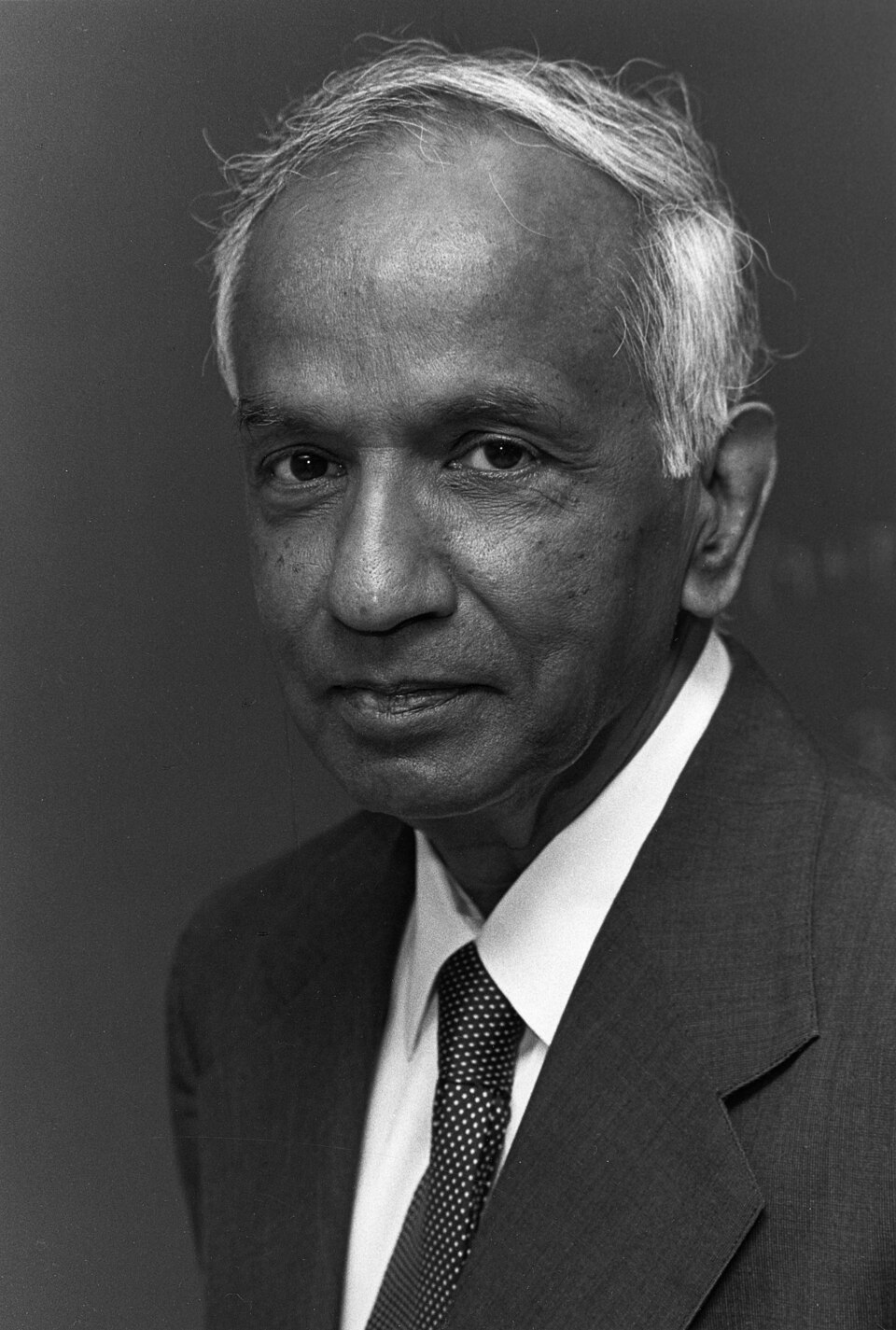
Subrahmanyan ChandrasekharFrom Proposing the Limit at 20 to Winning Nobel at 73
Ding Fire Day Master, Maverick Pattern with Geng Metal revealed, 0% Mentor Star in chart—proposed the 'Chandrasekhar Limit' at age 20, suppressed by academia for half a century, won Nobel at 73. The chart encodes a complete cycle: early fame as a Maverick, long-term suppression, and belated recognition in old age.
BaZi Chart
Core Analysis
Chandrasekhar was born on October 19, 1910. The three pillars are Geng Xu, Bing Xu, Ding Si. Day Master Ding Fire born in Xu month. The chart structure is interesting: the Year and Month pillars both have Xu Earth, amplifying the Maverick energy (Xu contains Wu Earth, Xin Metal, Ding Fire). Month stem Bing Fire as Rival supports the self. The entire chart's Maverick energy is extremely strong—but Mentor Star (正印 + 偏印) energy accounts for 0% of the total Ten Gods, making it one of the representative cases with zero Mentor Star among 114 Nobel samples.
His chart's energy mainly comes from Talent + Maverick and Rival + Peer: Day branch Si Fire supports the self, Month stem Bing Fire as Rival is an ally, Year and Month Xu Earth emit Talent and Maverick. This structure naturally belongs to the 'early-wit + self-energy-driven' type—no need for external knowledge inheritance, able to open new fields with innate talent.
Chandrasekhar's life trajectory perfectly matches this BaZi structure:
- Born in 1910 in Lahore, India, showed exceptional mathematical talent in youth.
- In 1930, at age 20, on a ship from India to Cambridge, England, he independently derived the famous 'Chandrasekhar Limit'—the maximum mass of a white dwarf is about 1.4 solar masses; beyond this limit, stars collapse into neutron stars or black holes. This is one of the most important discoveries in 20th-century astrophysics.
- In 1935, at age 25, he publicly presented the discovery at a meeting of the Royal Astronomical Society, but was fiercely denied on the spot by the then-academic authority Eddington—this blow suppressed his discovery internationally for nearly 40 years.
- From 1937, he taught at the University of Chicago, spending his life there.
- In 1983, at age 73, he finally won the Nobel Prize in Physics—53 years after proposing the limit at 20.
Chandrasekhar's chart is another typical example of 'zero Mentor Star + strong Talent-Maverick type scientist'—similar to Steven Chu but more extreme. The difference from Chu is: Chu jumped innovatively across different fields throughout his life, while Chandrasekhar deeply cultivated one field (theoretical astrophysics) relying on his own Talent-Maverick energy rather than Mentor Star accumulation. Both types can produce Nobel-level results, but both are completely different from the Mentor Star type.
Explore More
Beyond celebrity case studies, ShunShi can provide equally deep personal BaZi analysis for you.
Trait Analysis
Early-Wit Genius at 20
Chart has 0% Mentor Star + extremely strong Maverick energy—a classic 'no external inheritance, rely on innate talent' type. Independently derived the Chandrasekhar Limit at 20. This 'making world-class discoveries at a young age independently' is a hallmark of strong Talent-Maverick charts, completely opposite to the 'crowned at 60' rhythm of Mentor Star scientists.
Chart Signal of Suppression by Authority
The structure of Year stem Geng Metal as Earner directly clashing with Month pillar Rival, plus zero Mentor Star without official seal buffer, means the native naturally tends to conflict with authority. Being publicly denied by Eddington in 1935 was not accidental—it was the inevitable manifestation of the chart structure encountering the authority of the era. Such natives will clash with some authority system at least once in their lives.
Recognition Delayed by 53 Years
The interval from discovery at 20 to Nobel at 73 is 53 years, one of the longest 'discovery to recognition' gaps in 20th-century Nobel history. This is the inevitable result of zero Mentor Star and being poor at 'self-packaging' within the academic system. It also proves that while Talent-Maverick scientists produce quickly, they are recognized slowly—a structural misalignment between chart and system.
FAQ
丁巳日柱名人





Comments
No comments yet. Be the first!
Explore More
Beyond celebrity case studies, ShunShi can provide equally deep personal BaZi analysis for you.