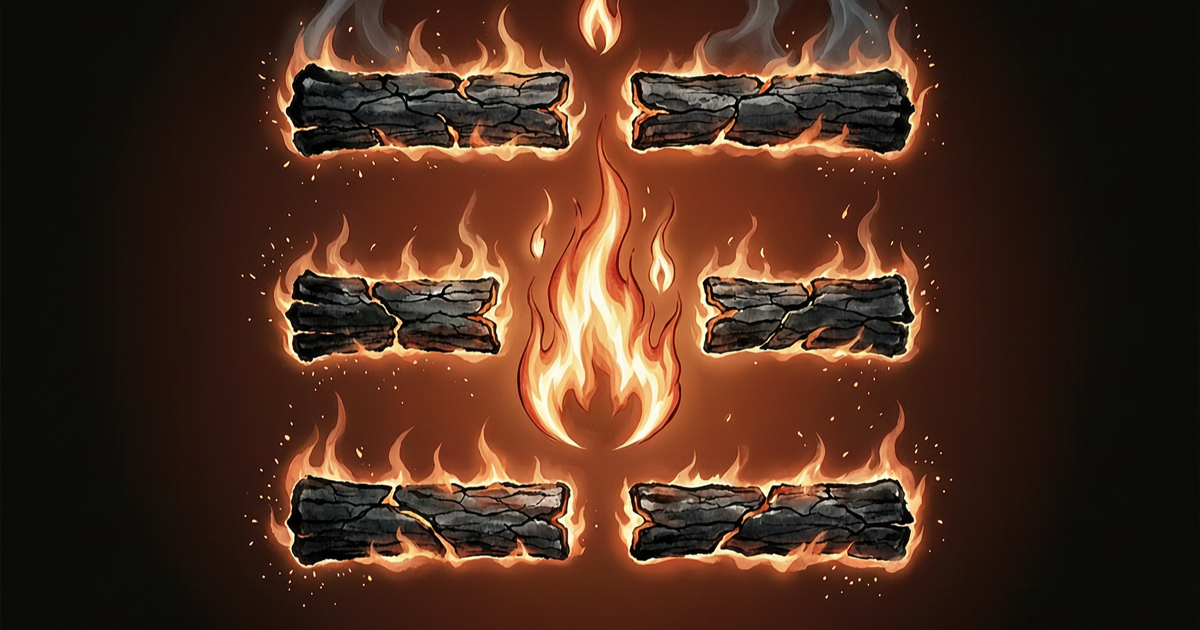
Fire shines, but it cannot exist alone—it must attach to something to burn. This one sentence is the deepest secret of the Li Hexagram.
If you look up the Li Hexagram or "Li is Fire" in the I Ching and see terms like "attachment," "brightness," or "middle daughter" but feel more confused, this article explains it in plain language: what the Li Hexagram is really about, why it represents both "brightness" and "dependence," and what life lessons are hidden in the relationship between this hexagram and the "fire" in your BaZi chart.
Bottom Line First
The Li Hexagram (☲) is one of the eight trigrams. Its upper and lower trigrams are both Li, symbolizing "fire." Its core spirit is "attachment"—that is, "clinging to shine." Fire must attach to wood, oil, or a wick to burn and emit light. Therefore, the Li Hexagram is never about "shining alone" but about "I must rely on the right object to illuminate." In the I Ching, it is the 30th hexagram, "Li is Fire." Its element is Fire, its direction is south, it represents the middle daughter among people, and corresponds to the eyes and heart in the body.
Applied to life lessons, the Li Hexagram offers a very practical reminder: Integrity is its strength, but "attachment" is a double-edged sword—attach to the right person or thing, and you shine; attach to the wrong one or burn too fiercely, and you get anxiety, exhaustion, and blurred vision. This is the same principle as "excessive fire" causing impatience or "insufficient fire" causing listlessness in BaZi, just expressed in a different language.
Try your own BaZi reading
Get an AI-powered personalized BaZi analysis from your birth info.
Start free analysisWhat Does the Li Hexagram Look Like? Two Fires Stacked Together
The symbol of the Li Hexagram is ☲: a solid line at the bottom, a broken line in the middle, and a solid line at the top—solid on the outside, empty on the inside. This structure is crucial; remember it, because all meanings grow from here.
In the 64 hexagrams, the Li Hexagram stacks this three-line Li trigram on top of itself, forming the 30th hexagram, "Li is Fire" (☲ above, ☲ below). Two fires stacked together create even greater brightness, so it is also called "double brightness" or "brightness doubled."
Many people intuitively think, "Isn't fire the most vigorous and solid? Why is it empty (broken line) in the middle?" This is precisely the beauty of the Li Hexagram:
- Solid on the outside (two solid lines): Fire appears intense, bright, and expanding outward.
- Empty on the inside (one broken line): Fire's essence is actually "empty"; it has no form of its own and must attach to something else to exist.
Thus, the virtue of the Li Hexagram is summed up in one word: "Li"—not meaning beauty, but "attachment" or "clinging." Once you understand "bright outside, empty inside, born through attachment," you have grasped the soul of the Li Hexagram.
What Do the Hexagram and Line Statements Say? The "Nurturing" and "Measure" of Fire
The hexagram statement of the Li Hexagram in the I Ching is: "Li, beneficial to be steadfast, smooth. Raising a cow, auspicious."
In plain language: The Li Hexagram is suitable for upholding righteousness and brings smooth progress. It specifically points out—raising a cow will be auspicious. Why a cow? Because cows are gentle, and a female cow is even more docile. Fire by nature is fierce and restless; the hexagram statement essentially reminds us: Those who shine must also cultivate gentleness. Fierce fire paired with gentleness prevents self-destruction. This is the first layer of "measure" taught by the Li Hexagram.
I won't list every line statement here, but I'll pick the two that best represent the spirit of the Li Hexagram:
- First Nine: "Treading with care, be respectful, no fault." When fire is first lit, steps are chaotic. At this time, maintain reverence and caution, and there will be no mistake. This means—initial chaos is normal; just stay respectful and cautious.
- Top Nine: "The king uses it to go on expeditions, there is merit in cutting off heads." When fire burns most intensely, one must know to use it on the "target that should be eliminated" and stop in time, not burn everything in sight. This is the conclusion of "using brightness in the right place."
From beginning to end, the line statements of the Li Hexagram actually deal with the same issue: Where should this fire attach, and to what degree should it burn to be just right? Too weak, and there is no light; too strong, and it consumes itself. Measure is the core lesson the Li Hexagram offers.
The Five Elements, Direction, and Body Correspondences of the Li Hexagram: South, Middle Daughter, Eyes, and Heart
Placing the Li Hexagram into the coordinate system of fortune analysis, its correspondences are fixed and form the bridge connecting it to BaZi:
- Five Elements: Fire: The Li Hexagram is pure fire energy. To understand the complete character of fire in fortune analysis, you can first read Fire in the Five Elements, then return to the Li Hexagram for deeper insight; fire is just one part of the Five Elements system, and the generating and overcoming cycles among the Five Elements form the underlying logic of fortune analysis.
- Direction: South: South belongs to fire, the hottest and brightest.
- Among people: Middle daughter: In the trigram-family correspondence, Li is the "middle daughter" (second daughter). This echoes its temperament of "soft on the outside, bright inside, needing attachment."
- Body: Corresponds to the eyes (the organ that sees light) and the heart (the heart belongs to fire in Chinese medicine). Traditionally, imbalance in the Li Hexagram is often linked to eye diseases, restlessness, and insomnia.
- Temperament: Intelligent, literary, values appearance and face, passionate but easily impatient, with a strong tendency toward dependence.
Among the twelve Earthly Branches, the strongest fire is the branch "Wu" (午) (due south, pure yang fire). The energy field of the Li Hexagram resonates highly with Wu—this is why many people with strong fire often exhibit typical "Li Hexagram traits": bright and extroverted, seeking attention, and quick to ignite.
Life Lessons of the Li Hexagram: Attachment, Integrity, and the Golden Mean
The most valuable aspect of the Li Hexagram is not the label "it represents fire," but the three real-life challenges it presents. This is what sets it apart from the Kun and Zhen hexagrams—
First Lesson: Attachment (Finding the Right "Fuel"). Fire cannot ignite itself; it must attach. In life, this means people of the Li Hexagram type draw energy from "objects of attachment": a stage, a job where they are seen, a relationship, an audience. Attach correctly, and you shine brilliantly; attach to the wrong person or thing, and you exhaust yourself without illuminating anything. The Li Hexagram's reminder is not "don't attach," but "choose carefully whom or what you attach to."
Second Lesson: Integrity (Fire Cannot Hide). Fire is inherently public and outward; it cannot be concealed. Thus, Li Hexagram types find it hard to play dirty—they reveal themselves immediately, written all over their face and eyes. Instead of forcing depth, it's better to play the card of transparency, integrity, and daring to be seen. This is the Li Hexagram's talent, not a flaw.
Third Lesson: The Golden Mean (Fire Must Know When to Stop). This is where the Li Hexagram most easily trips people up. When fire is too strong, people become impatient, restless, and burn themselves out—in life, this translates to excessive attention-seeking, emotional volatility, and chronic insomnia and exhaustion. The hexagram statement advises "raising a cow" (cultivate gentleness), and the top line advises "cutting off heads" (know when to stop)—both teach "those who shine must also know how to turn off the fire."
Connecting these three lessons, the Li Hexagram actually teaches one thing: You are someone who shines, but shining has conditions and limits—choose your attachment point wisely, dare to be open, and know when to extinguish the fire.
Is the Fire of the Li Hexagram the Same as the Fire in Your BaZi?
This is the key difference I most want to convey in this article, and the crucial point for "grounding" the hexagram image to your own situation.
The Li Hexagram talks about the archetype of fire—an abstract energetic character. The fire in your BaZi, however, is concrete and has weight: whether it is too strong, just right, or too weak in your chart determines which form the "lessons of the Li Hexagram" will take in your life.
- Those with excessive fire in their BaZi: Naturally carry the intensity of the Li Hexagram—intelligent, extroverted, charismatic on stage, but most likely to get stuck on the "third lesson": impatience, burnout, emotional highs and lows. For you, the Li Hexagram's lesson is "learning to turn off the fire."
- Those with insufficient fire in their BaZi: Lack that light—tend to appear listless, lack passion and confidence, and see things dimly. For you, the Li Hexagram's lesson is the opposite: "how to ignite the fire and attach it to the right things" to make yourself shine.
- Those with balanced fire in their BaZi: Closest to the ideal state of "Li, beneficial to be steadfast, smooth"—having light while maintaining measure.
Thus, the same statement "the Li Hexagram speaks of attachment and brightness" yields completely different prescriptions for different people. Reading the hexagram is only the first step; what truly matters is the strength of your own fire. Instead of guessing based on general principles, directly use the BaZi chart calculator to generate your natal chart and see whether your fire is excessive, insufficient, or balanced—this is the step that turns the Li Hexagram from "knowledge" into something "useful for you."
Li Hexagram vs. Kun and Zhen Hexagrams: Each Trigram Has Its Own Temperament
If you are reading through the eight trigrams one by one, a quick comparison will help you remember better:
- Li Hexagram (Fire): Bright outside, empty inside, shines through attachment; the lesson is "measure and choosing the right attachment point."
- Kun Hexagram (Earth): All six lines are broken, pure receptivity and tolerance; the lesson is "thick virtue carries all things, gentle accumulation."
- Zhen Hexagram (Thunder): One yang line stirs below, symbolizing the start of a new situation; the lesson is "stand firm amidst upheaval."
Fire shines outward, earth carries downward, thunder shakes upward—three trigrams with three completely different energy directions. The reason the eight trigrams can form 64 hexagrams and judge all things is that each trigram has its own distinct temperament. To learn from the beginning how to use these trigrams for divination and inquiry, you can next read Beginner's Guide to I Ching Divination.
Frequently Asked Questions
Q: Is the Li Hexagram good or bad? No hexagram is absolutely good or bad. The Li Hexagram represents brightness, intelligence, and literary talent—these are strengths. But fire's restlessness, dependence, and tendency to burn out are its hidden dangers. The key lies in "where the fire attaches and how fiercely it burns." Used correctly, it is auspicious; overdone, it is inauspicious.
Q: Are "Li is Fire" and "Li Hexagram" the same thing? There is a slight difference in level. "Li Hexagram" can refer to the three-line single trigram (☲) among the eight trigrams, and is often used loosely. "Li is Fire" specifically refers to the 30th hexagram formed by stacking two Li trigrams in the 64 hexagrams. In everyday talk about "Li Hexagram fortune," it usually refers to the "Li is Fire" hexagram.
Q: If my BaZi has very strong fire, does that equal the Li Hexagram? You cannot directly equate them. The Li Hexagram is an abstract fire archetype; the fire in your BaZi is a specific measure of strength. People with strong fire indeed tend to carry the intensity and lessons of the Li Hexagram, but the actual manifestation also depends on the entire chart configuration. For accurate judgment, it is recommended to generate a chart and examine the strength of the Five Elements.
Conclusion: Those Who Shine Must Also Know How to Turn Off the Fire
The most touching aspect of the Li Hexagram is that it honestly admits one thing—No matter how bright fire is, it cannot burn alone. It must attach, it must have measure, and it must choose the right object to cling to. This is not weakness, but the inherent condition of the energy called "light."
Next time you see "Li Hexagram" or "Li is Fire," you no longer need to be confused by terms like "attachment" or "middle daughter." Just remember one sentence: The Li Hexagram is a light that must attach, must have measure, and cannot hide. And whether your own light is too strong, too weak, or just right is already written in your chart—generate your BaZi once, and you will know yourself better than by reading any number of hexagram articles.